A meeting summary is a concise record of the most important outcomes from a meeting. It captures key discussion points, decisions, action items, responsibilities, and next steps so participants have a shared understanding of what was discussed and what needs to happen afterward.
Without a clear written summary, important details can easily be forgotten or interpreted differently by different participants. A well-prepared meeting summary creates a reliable reference point for attendees and people who were unable to attend. It also supports accountability by documenting who is responsible for specific tasks and when those tasks are expected to be completed.
Whether you are documenting a team meeting, project meeting, client discussion, staff meeting, committee session, or management review, a structured meeting summary can make communication more efficient and keep work moving forward.
What Is a Meeting Summary?
A meeting summary is a written recap of the important information discussed and decided during a meeting. It is generally shorter and more focused than a full meeting transcript or detailed set of minutes.
The purpose is to capture the information that participants need after the meeting. This commonly includes the meeting purpose, major discussion topics, decisions, action items, assigned responsibilities, deadlines, and next steps.
A good summary focuses on outcomes rather than attempting to record every sentence spoken during the meeting. This makes the document easier to read and more useful as a reference.
Why Is a Meeting Summary Important?
Meetings often involve multiple topics, participants, decisions, and follow-up tasks. A written summary helps turn those conversations into a clear record that can be used after the meeting ends.
- Improves clarity: Participants can review what was discussed and agreed upon.
- Creates accountability: Action items can be connected to specific people and deadlines.
- Prevents misunderstandings: Written decisions provide a shared reference point.
- Keeps absent participants informed: People who could not attend can quickly understand the outcomes.
- Tracks progress: Previous action items can be reviewed during future meetings.
- Supports transparency: Teams have a documented record of important discussions and decisions.
- Saves time: Participants do not need to reconstruct the meeting from memory.
What Should a Meeting Summary Include?
The exact format can vary depending on the type of meeting, but a useful summary should contain enough information for someone to understand the important outcomes without reading the entire meeting discussion.
Meeting Details
Start with basic information such as the meeting title, date, time, location or meeting format, organizer, facilitator, note taker, and attendees.
These details make the document easier to identify and provide useful context when the summary is reviewed later.
Meeting Purpose
Briefly explain why the meeting was held. The purpose might be to review project progress, resolve a specific issue, make a decision, plan an upcoming event, or discuss a business objective.
Key Discussion Points
Summarize the major subjects discussed during the meeting. Focus on important information, issues raised, alternatives considered, and conclusions reached.
Decisions Made
Clearly document decisions that were reached during the meeting. A decision section helps distinguish confirmed outcomes from general discussion or ideas that were simply considered.
Action Items
List tasks that need to be completed after the meeting. Whenever possible, include the person responsible, due date, and current status.
Next Steps
Summarize what should happen next. This may include follow-up meetings, additional research, approvals, communications, project work, or other activities.
Additional Notes
Use an additional notes section for important information that does not fit naturally into the other sections. Keep these notes relevant to the meeting and avoid turning the summary into an unnecessary transcript.
Meeting Summary Template
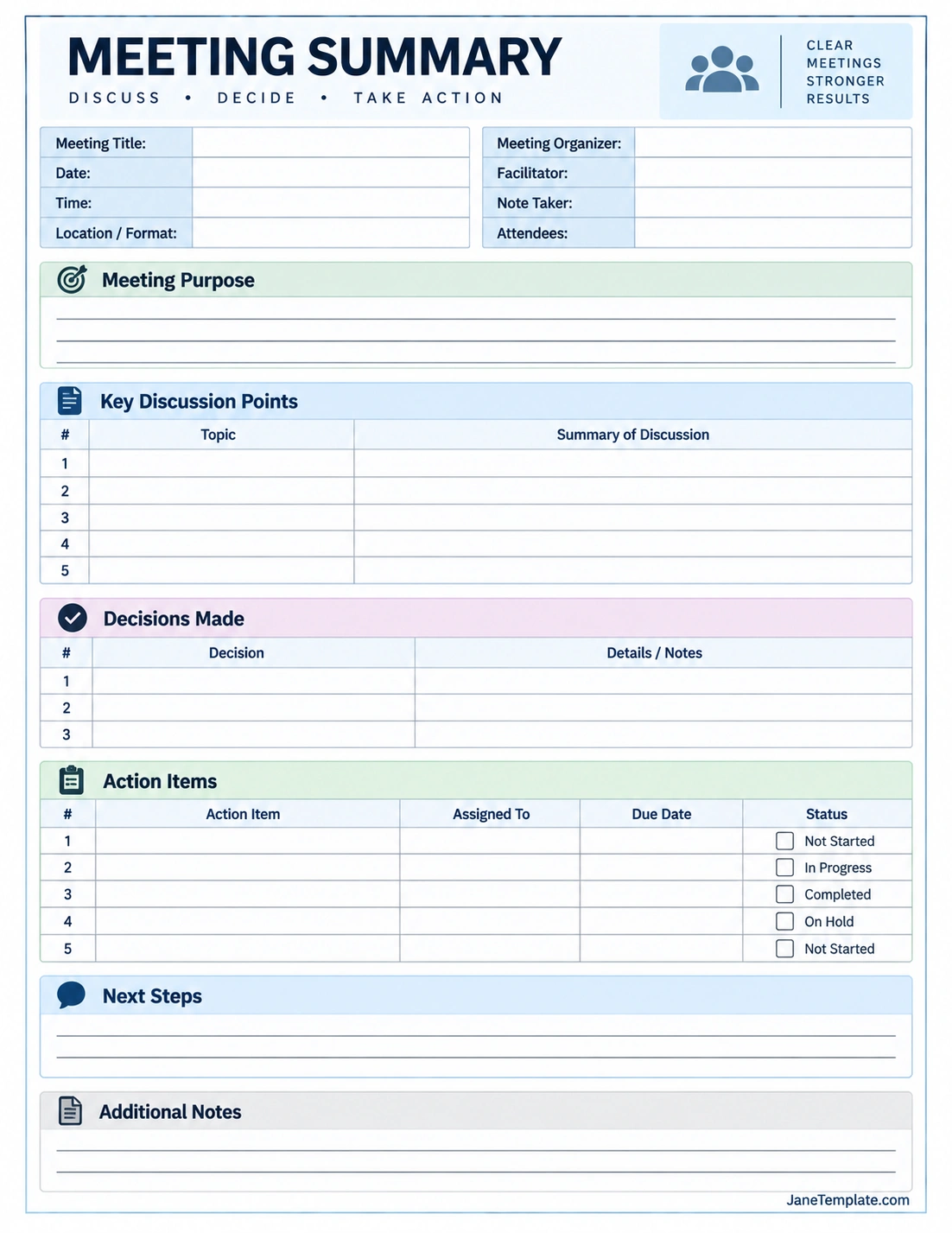
A Meeting Summary Template provides a structured way to document the most important outcomes of a meeting. Instead of creating a new format each time, you can use the same basic worksheet for recurring team meetings, project discussions, or business reviews.
How to Write a Meeting Summary
Writing a useful meeting summary starts with identifying the information that matters most. The goal is to create a concise record that someone can understand without needing to ask participants what happened.
Start With the Meeting Details
Record the date, time, meeting title, location or format, organizer, facilitator, note taker, and attendees. This establishes the context for the document.
Summarize Important Discussions
Review your notes and identify the topics that had meaningful discussion. Summarize the main points rather than copying every comment or statement.
Separate Decisions From Discussions
Not every topic discussed results in a decision. Keep confirmed decisions in a separate section so readers can quickly identify what was actually agreed upon.
Record Action Items
Write down each task that requires follow-up. Identify the responsible person and expected completion date whenever that information is available.
Finish With Next Steps
End the summary with a clear description of what happens next. This gives the team a practical direction after the meeting.
Meeting Summary vs. Meeting Minutes
A meeting summary and meeting minutes are closely related, but they do not always serve exactly the same purpose.
Meeting minutes are often more formal and may document the meeting’s proceedings, attendance, motions, votes, resolutions, and other official records. They are particularly common for boards, committees, associations, and formal organizations.
A meeting summary is generally more concise and focuses on key outcomes, decisions, and follow-up actions. It is often suitable for everyday business meetings, project meetings, team discussions, and informal planning sessions.
The appropriate format depends on the organization’s requirements and the purpose of the document.
Meeting Summary vs. Meeting Notes
Meeting notes are usually the personal or working notes taken during a meeting. They may contain incomplete sentences, reminders, observations, questions, and rough details.
A meeting summary is a polished document created from those notes. It removes unnecessary information and presents the important outcomes in an organized format.
In simple terms, meeting notes help the note taker remember what happened, while a meeting summary helps the broader group understand what matters after the meeting.
How to Make a Meeting Summary More Effective
A useful summary should be easy to scan. Participants should be able to find decisions and action items without reading several pages of text.
- Use clear headings: Separate discussions, decisions, and action items.
- Keep sentences concise: Focus on meaningful information.
- Use bullet points: They make multiple actions and discussion points easier to scan.
- Highlight responsibilities: Clearly identify who is responsible for each action item.
- Include deadlines: Dates help transform general tasks into trackable commitments.
- Distinguish decisions from suggestions: This prevents ideas from being mistaken for approved actions.
- Use consistent formatting: A standard template makes recurring summaries easier to prepare and review.
How to Capture Better Meeting Information
The quality of a meeting summary depends heavily on the information captured during the meeting. A few simple habits can make the writing process much easier.
Listen for Decisions
Pay particular attention when participants reach an agreement or make a formal decision. Write the outcome clearly while it is still fresh.
Track Action Items Immediately
When a task is assigned, record the task, responsible person, and deadline at the same time. Waiting until after the meeting can increase the chance of missing important details.
Clarify Ambiguous Statements
If a discussion produces an unclear responsibility or deadline, ask for clarification before the meeting ends. A short clarification can prevent significant confusion later.
Focus on Outcomes
Do not attempt to capture every sentence. Concentrate on information that affects decisions, responsibilities, project progress, risks, deadlines, or future actions.
When Should a Meeting Summary Be Sent?
A meeting summary is generally most useful when it is distributed while the discussion is still fresh in participants’ minds. Sending it soon after the meeting allows participants to identify misunderstandings and correct inaccurate information before work progresses too far.
For meetings involving important decisions or deadlines, timely distribution is particularly valuable. Participants can use the summary as a reference when beginning their assigned tasks.
If corrections are made, update the final version so that everyone is working from the same information.
How to Organize Meeting Action Items
Action items are one of the most valuable parts of a meeting summary because they convert discussion into specific follow-up work.
A useful action item should describe what needs to be done, who is responsible, and when it should be completed. If appropriate, include a status such as not started, in progress, completed, or on hold.
- Action item: The specific task that needs to be completed.
- Assigned to: The person responsible for the task.
- Due date: The expected completion date.
- Status: The current state of the task.
This structure makes it easier to review outstanding work during the next meeting and identify tasks that may require additional attention.
Meeting Summary for Different Types of Meetings
Team Meetings
A team meeting summary can focus on priorities, decisions, project updates, obstacles, and assigned tasks. Keeping the document concise helps team members quickly understand what they need to do next.
Project Meetings
Project summaries can document progress, milestones, risks, issues, decisions, dependencies, and action items. These records can become useful references throughout the project lifecycle.
Client Meetings
Client meeting summaries should clearly document topics discussed, requirements, decisions, requests, and agreed-upon follow-up actions. Accurate documentation can help maintain alignment between the client and project team.
Management Meetings
Management summaries may focus on strategic decisions, operational issues, responsibilities, deadlines, and matters requiring follow-up.
Committee Meetings
Committee meetings may require more formal documentation, particularly when decisions, recommendations, votes, or resolutions need to be recorded. Follow the organization’s specific documentation requirements.
Common Meeting Summary Mistakes
Writing a Full Transcript
A summary should not normally reproduce every statement from the meeting. Excessive detail can make important decisions and action items difficult to locate.
Leaving Out Responsibilities
An action item without an assigned owner may not be completed. Whenever possible, connect each task to a specific person or responsible group.
Not Recording Deadlines
A task without a target date can remain open indefinitely. Include a due date whenever one has been established.
Mixing Ideas With Decisions
Ideas discussed during a meeting should not automatically be presented as approved decisions. Clearly distinguish proposals, possibilities, and confirmed outcomes.
Waiting Too Long to Write the Summary
Delaying documentation can make it harder to remember important details. Preparing the summary soon after the meeting helps preserve accuracy.
Using an Inconsistent Format
If every meeting summary looks different, participants may have difficulty finding information. A standard template creates familiarity and makes recurring documentation more efficient.
Meeting Summary Checklist
Before distributing a meeting summary, review the document to make sure it contains the essential information.
- Meeting title and date are correct.
- Meeting time and location or format are included.
- Relevant attendees are listed.
- The purpose of the meeting is clear.
- Important discussion points are summarized.
- Confirmed decisions are clearly identified.
- Action items are documented.
- Responsibilities are assigned where appropriate.
- Due dates are included when available.
- Next steps are clear.
- Important additional notes are included.
- The summary has been reviewed for accuracy and clarity.
Conclusion
A meeting summary turns a conversation into a practical written record. By documenting key discussions, decisions, action items, responsibilities, and next steps, it helps teams maintain clarity and continue working toward shared objectives.
The most effective summary is concise, organized, and focused on outcomes. It should make it easy for attendees to remember what was agreed upon and for absent participants to understand what they missed.
Using a Meeting Summary Template can simplify the process by providing dedicated sections for meeting details, discussion points, decisions, action items, and follow-up information. With a consistent format and timely distribution, meeting summaries can improve communication, accountability, transparency, and overall follow-through.
Download: Meeting Summary Template
