Tracking monthly expenses is one of the simplest ways to understand where your money goes each month. By recording your income, planned spending, and actual expenses, you can see which categories take up the largest part of your budget and identify opportunities to adjust your spending.
A monthly expense tracker can also help you compare what you expected to spend with what you actually spent. This makes it easier to recognize spending patterns, stay accountable, prepare for upcoming bills, and work toward financial goals such as building savings or paying down debt.
You do not need a complicated financial system to get started. A clear monthly expenses template can provide a convenient place to record everyday purchases, recurring bills, savings contributions, and other financial obligations.
What Are Monthly Expenses?
Monthly expenses are the costs you pay or expect to pay during a particular month. They can include essential bills, everyday purchases, debt payments, savings contributions, and discretionary spending.
Some expenses occur at approximately the same amount every month, while others can change significantly. For example, rent may remain consistent, while groceries, dining out, transportation, and entertainment may vary.
Understanding these differences is important because your monthly spending is rarely made up of one single type of expense. Organizing expenses into categories provides a clearer picture of your overall financial activity.
Why Should You Track Monthly Expenses?
Keeping track of your spending can help turn scattered financial information into something easier to review. Instead of relying on memory, you can use actual numbers to understand your spending habits.
A monthly expense tracker can help you:
- Understand where your money is going
- Compare planned spending with actual spending
- Identify recurring expenses
- Find categories where spending is higher than expected
- Prepare for upcoming bills
- Monitor savings contributions
- Track debt payments
- Make informed budgeting decisions
- Stay accountable to your financial goals
Regular tracking can also make it easier to notice small expenses that become significant when repeated throughout the month.
Common Monthly Expense Categories
Creating categories makes an expense list easier to organize. The categories you use should reflect your own household and financial situation.
Housing
Housing is often one of the largest monthly expense categories. It may include rent or mortgage payments, property taxes, home insurance, and maintenance.
- Rent or mortgage
- Property taxes
- Home insurance
- Home maintenance
- Utilities
- Internet
Food
Food expenses can include groceries as well as meals purchased from restaurants, cafes, delivery services, or other places.
- Groceries
- Dining out
- Takeout
- Snacks and drinks
Transportation
Transportation costs vary depending on how you travel and whether you own a vehicle.
- Car payments
- Fuel
- Car insurance
- Maintenance and repairs
- Parking
- Public transportation
- Rideshare services
Personal Expenses
Personal expenses cover many everyday purchases and activities that are not included in housing, food, or transportation.
- Clothing
- Personal care
- Education
- Entertainment
- Hobbies
- Subscriptions
Debt and Savings
Debt payments and savings can be tracked separately because they are often connected to longer-term financial goals.
- Loan payments
- Credit card payments
- Emergency fund contributions
- Savings
- Other financial goals
Other Expenses
Some costs may not fit neatly into the main categories. These could include gifts, donations, childcare, pet care, miscellaneous purchases, or other irregular expenses.
Fixed vs. Variable Monthly Expenses
One useful way to understand your spending is to separate fixed expenses from variable expenses.
Fixed Expenses
Fixed expenses generally remain the same or close to the same from month to month. Examples may include rent, a mortgage payment, certain insurance premiums, or a recurring subscription.
Because these costs are relatively predictable, they can be easier to include in a monthly budget.
Variable Expenses
Variable expenses can change from one month to another. Groceries, fuel, dining out, entertainment, and household purchases are common examples.
Variable expenses may require more frequent monitoring because the final amount is not always known in advance.
How to Track Monthly Expenses
Tracking your expenses becomes easier when you use the same process consistently each month.
Step 1: Record Your Income
Start by identifying the income available for the month. Depending on your situation, this could include wages, self-employment income, or other regular sources of income.
Use the amount that is appropriate for your budgeting method and time period.
Step 2: List Recurring Expenses
Write down recurring bills and payments first. These are expenses you expect to pay regularly and can form the foundation of your monthly plan.
Step 3: Add Variable Expenses
Estimate categories that change throughout the month, such as groceries, transportation, entertainment, and household purchases.
Step 4: Record Actual Spending
As the month progresses, enter what you actually spend. Recording expenses regularly is generally more reliable than trying to reconstruct an entire month from memory.
Step 5: Compare Budget and Actual Amounts
At the end of the month, compare your planned amounts with your actual spending. This can reveal categories where your estimates were accurate and categories that need adjustment.
Step 6: Review the Results
Look for meaningful patterns rather than focusing only on individual purchases. Ask which categories consistently exceed your expectations and which areas remain below budget.
How to Use a Monthly Expenses Template
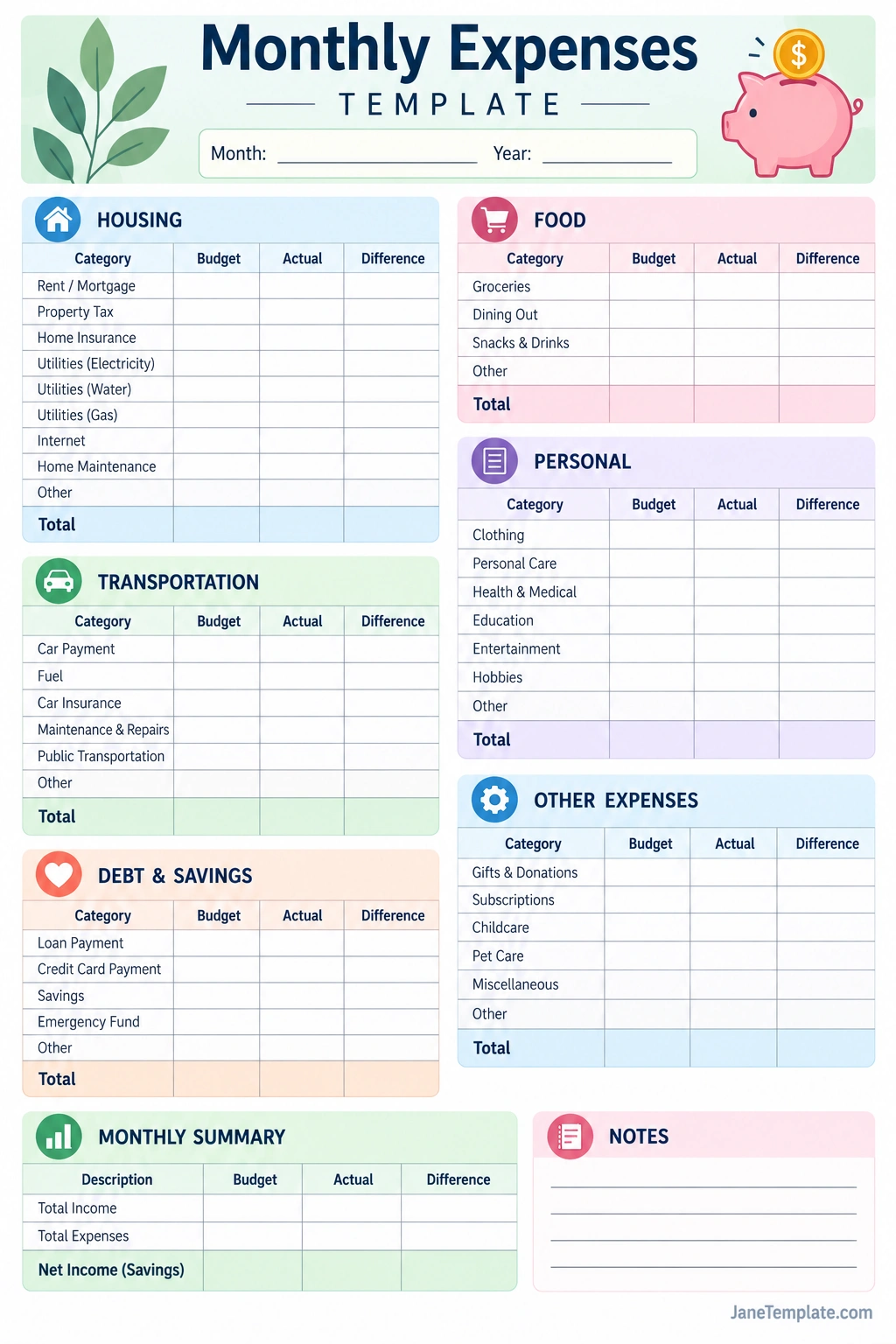
A monthly expenses template gives you a structured place to organize your financial information. A useful template can include columns for the expense category, budgeted amount, actual amount, and difference.
For example, you might enter a planned grocery budget and then record your actual grocery spending throughout the month. The difference column can show whether your actual spending was above or below the amount you planned.
A template may also include separate sections for:
- Income
- Housing
- Food
- Transportation
- Personal expenses
- Debt payments
- Savings
- Other expenses
- Monthly totals
- Notes
This structure makes it easier to review the entire month without searching through individual receipts or notes.
Budgeted Amount vs. Actual Spending
One of the most useful features of a monthly expense tracker is the ability to compare your budget with actual spending.
The budgeted amount is what you planned or expected to spend. The actual amount is what you ultimately spent. Comparing the two can help you identify differences and make better estimates for future months.
For example, if you budgeted $400 for groceries but spent $475, you have a $75 difference to investigate. That does not automatically mean the spending was inappropriate. It simply gives you information to consider when reviewing your budget.
Likewise, spending less than expected in one category may create additional flexibility elsewhere, depending on your overall financial plan.
How to Identify Areas Where You Can Cut Costs
Once you have tracked your expenses for several weeks or months, patterns may become easier to see. Instead of making assumptions about your spending, use your records to identify categories that deserve closer attention.
Look for Repeated Purchases
Small purchases made frequently can add up over a month. Reviewing the actual total can help you decide whether the category deserves a different budget.
Review Subscriptions
Recurring subscriptions can be easy to overlook because individual charges may seem small. Review your subscription expenses periodically and consider whether each service is still useful to you.
Compare Essential and Discretionary Spending
Separate expenses that are necessary from spending that is more flexible. This can help you identify which categories may offer more room for adjustment.
Examine High-Variation Categories
If a category changes significantly from month to month, look at what causes those changes. Understanding the reason can help you create more realistic future budgets.
How Monthly Expense Tracking Can Support Financial Goals
Tracking expenses is not an end in itself. The information can be used to support broader financial goals.
For example, someone saving for an emergency fund may use monthly spending information to determine how much money can reasonably be set aside. Someone working toward paying down debt may track payments and review other spending categories for potential adjustments.
Common goals include:
- Building an emergency fund
- Saving for a major purchase
- Preparing for irregular expenses
- Reducing unnecessary spending
- Paying down debt
- Increasing regular savings
- Creating a more predictable monthly budget
The appropriate goal depends on your individual circumstances and financial priorities.
Monthly Expenses Checklist
A simple checklist can help ensure that important expense categories are not forgotten during your monthly review.
- Review total monthly income
- Record housing expenses
- Record utility bills
- Track groceries and dining expenses
- Track transportation costs
- Record personal spending
- Review subscriptions
- Record debt payments
- Record savings contributions
- Add irregular or miscellaneous expenses
- Calculate category totals
- Compare budgeted and actual amounts
- Review differences
- Set priorities for the next month
Tips for Managing Monthly Expenses
Expense tracking works best when it becomes a regular habit rather than a once-a-year activity.
- Update your tracker regularly: Recording expenses throughout the month can make your records more accurate.
- Keep categories consistent: Using the same categories each month makes comparisons easier.
- Review recurring bills: Check regular charges periodically so they do not disappear from your attention.
- Separate planned and actual spending: This makes it easier to identify differences.
- Account for irregular costs: Annual or occasional expenses can still affect your monthly financial plan.
- Review before the next month begins: Use what you learned from the previous month to improve future estimates.
Common Monthly Expense Tracking Mistakes
Even a simple expense tracker can become less useful if information is incomplete or inconsistent.
- Relying entirely on memory
- Forgetting small purchases
- Ignoring recurring subscriptions
- Combining unrelated categories
- Failing to record irregular expenses
- Never comparing actual spending with the budget
- Setting unrealistic spending targets
- Reviewing expenses only when there is a financial problem
The purpose of tracking is to create useful information. The more consistently you record and review your expenses, the easier it becomes to recognize patterns.
Monthly Expenses for Different Households
There is no single list of monthly expenses that applies to everyone. A college student may have different categories from a homeowner, while a family with children may have expenses that do not apply to a single-person household.
For this reason, your expense tracker should be customizable. Start with common categories, then add or remove sections based on your actual needs.
For example, a household may need categories for childcare and school expenses, while a student may need categories for tuition, books, transportation, and housing. The goal is to create a system that accurately reflects your financial situation.
Frequently Asked Questions About Monthly Expenses
What are monthly expenses?
Monthly expenses are the costs you pay or expect to pay during a month. They can include housing, food, transportation, utilities, personal spending, debt payments, savings, and other costs.
How do I track my monthly expenses?
List your income and expense categories, record planned amounts, enter actual spending throughout the month, and compare your budget with your actual results at the end of the month.
What should be included in a monthly expenses tracker?
A monthly expenses tracker can include income, housing, utilities, food, transportation, personal expenses, debt, savings, subscriptions, and miscellaneous costs. The categories should be customized to your household.
What is the difference between fixed and variable expenses?
Fixed expenses generally stay the same or close to the same from month to month, while variable expenses can change depending on usage, purchases, or circumstances.
Why should I compare budgeted and actual expenses?
Comparing budgeted and actual expenses shows where your estimates matched your spending and where they differed. This information can help you make more informed decisions when planning future months.
Can a monthly expenses template help me save money?
A monthly expenses template can make spending patterns easier to see and may help you identify categories that deserve closer attention. The information can then be used when making your own budgeting and spending decisions.
Conclusion
Tracking monthly expenses gives you a clearer view of how your money is being used throughout the month. By organizing spending into categories and comparing budgeted amounts with actual results, you can identify patterns and make more informed financial decisions.
A simple monthly expenses template can make this process easier by providing dedicated sections for income, housing, food, transportation, personal spending, debt, savings, and other costs. You can customize the categories to match your household and financial priorities.
The most important part is consistency. By recording expenses regularly and reviewing the results at the end of each month, you can build a clearer understanding of your spending habits and use that information to plan future months more effectively.
Download: Monthly Expenses Template
