An NDA disclosure agreement is a legal contract designed to protect sensitive or confidential information from unauthorized use or disclosure. It creates a confidential relationship between the parties and establishes rules for how private information may be received, used, protected, and shared.
Businesses, employers, startups, consultants, contractors, and individuals may use a Non-Disclosure Agreement (NDA) when confidential information needs to be shared with another party. The agreement can help protect business plans, customer information, technical data, product ideas, trade secrets, marketing strategies, and other information that should not be publicly disclosed.
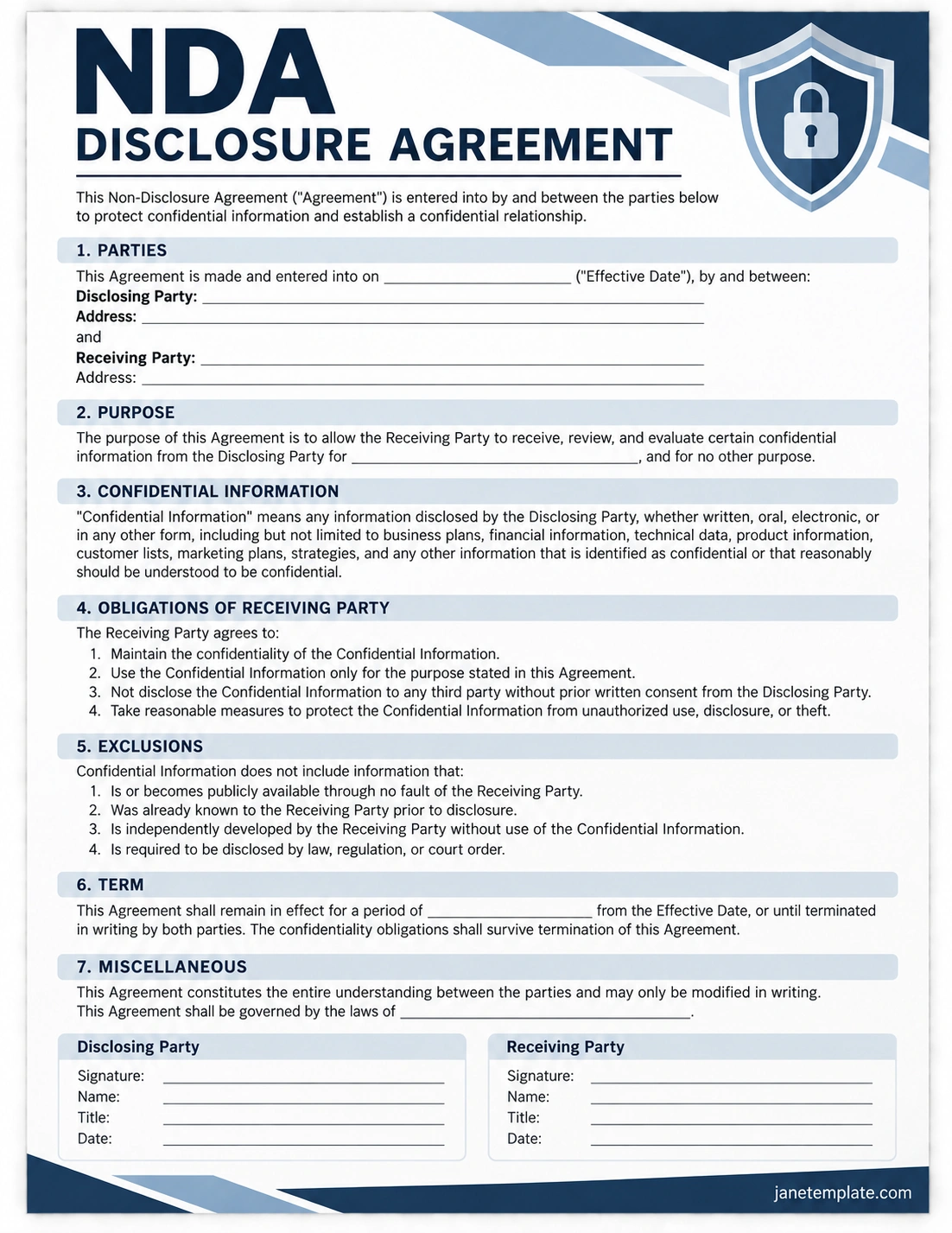
A well-prepared NDA should clearly identify the parties, define confidential information, explain the permitted purpose for using that information, establish the receiving party’s obligations, and specify how long confidentiality requirements remain in effect.
Important: An NDA is a legal document, and laws and enforceability requirements vary by jurisdiction. The information in this article is for general educational purposes and is not a substitute for advice from a qualified attorney.
What Is an NDA Disclosure Agreement?
An NDA disclosure agreement, commonly called a Non-Disclosure Agreement, is a contract in which one or more parties agree to protect confidential information. The party providing the information is generally called the Disclosing Party, while the party receiving it is called the Receiving Party.
The agreement establishes contractual obligations regarding confidential information. Depending on the terms, the Receiving Party may be required to use the information only for a specific purpose, restrict access to authorized individuals, protect the information from unauthorized disclosure, and return or destroy confidential materials when requested.
An NDA can be mutual or one-sided. A one-way NDA generally protects information disclosed by one party, while a mutual NDA can protect confidential information shared by both parties.
Why Use an NDA Disclosure Agreement?
Confidential information can have significant business or strategic value. Sharing information without clear contractual protections can create unnecessary risks. An NDA provides a framework for establishing confidentiality obligations before sensitive information is disclosed.
- Protects confidential information: Establishes contractual obligations for handling sensitive information.
- Defines permitted use: Explains why the Receiving Party is allowed to access the information.
- Limits unauthorized disclosure: Establishes restrictions on sharing confidential information with third parties.
- Protects intellectual property: Can help safeguard information related to products, technology, research, and business development.
- Clarifies expectations: Both parties understand their responsibilities before information is exchanged.
- Supports business relationships: Provides a formal confidentiality framework for negotiations and collaborations.
When Should You Use an NDA?
An NDA may be appropriate whenever confidential information needs to be shared with another person or organization. The specific need depends on the nature of the relationship and the information involved.
Business Partnerships
Companies may exchange confidential business plans, customer information, financial information, product concepts, or strategic plans while discussing a potential partnership.
Employees and Contractors
Employees and independent contractors may have access to confidential business information while performing their work. An NDA can establish contractual expectations regarding how that information should be handled.
Potential Investors
A company may need to share sensitive business information during discussions with potential investors. Whether an NDA is appropriate depends on the circumstances and the information being disclosed.
Product Development
Businesses working on new products, services, technologies, designs, or prototypes may use confidentiality agreements to establish restrictions around information shared with collaborators or vendors.
Mergers and Acquisitions
During a potential acquisition or business transaction, parties may review confidential financial, operational, customer, and strategic information. An NDA can establish confidentiality obligations during the evaluation process.
Key Elements of an NDA Disclosure Agreement
A strong NDA should clearly explain the relationship between the parties and the rules that apply to confidential information. The exact provisions should be adapted to the situation and applicable law.
1. Identification of the Parties
The agreement should identify the Disclosing Party and Receiving Party. Depending on the relationship, the parties may be individuals, companies, partnerships, or other legal entities.
2. Effective Date
The effective date identifies when the agreement begins. This date can be important when determining when confidentiality obligations apply.
3. Purpose of the Agreement
The NDA should explain why confidential information is being shared. For example, information may be provided so that the Receiving Party can evaluate a potential business relationship or perform services for the Disclosing Party.
4. Definition of Confidential Information
The agreement should clearly describe what information is considered confidential. Depending on the circumstances, this may include business plans, customer lists, technical information, research, designs, processes, pricing information, strategies, or other proprietary information.
5. Receiving Party Obligations
The agreement should explain what the Receiving Party must do to protect confidential information. Common obligations may include maintaining confidentiality, using information only for the agreed purpose, limiting access, and taking reasonable measures to prevent unauthorized disclosure.
6. Exclusions from Confidential Information
An NDA commonly identifies information that is not considered confidential. Examples may include information that is already publicly available, was lawfully known before disclosure, was independently developed, or must be disclosed because of a legal requirement.
7. Duration and Term
The agreement should specify how long the NDA remains in effect and, where applicable, how long confidentiality obligations continue after the relationship or agreement ends.
8. Governing Law
The NDA may identify the jurisdiction and governing law that will apply to the agreement. This provision should be drafted carefully because legal requirements vary by location.
9. Signatures
The agreement should include signature sections for the relevant parties. Depending on the parties and jurisdiction, the document may also require names, titles, dates, or other execution details.
Types of NDA Disclosure Agreements
Not every confidentiality agreement is structured in exactly the same way. The appropriate format depends on who is sharing information and who needs protection.
One-Way NDA
A one-way NDA generally protects confidential information provided by one party to another. The Receiving Party agrees to protect and use the information according to the terms of the agreement.
Mutual NDA
A mutual NDA is designed for situations where both parties may exchange confidential information. Each party can have obligations to protect information received from the other party.
Employee NDA
An employee NDA may address confidential information an employee encounters during employment. It can cover business information, customer information, technical information, and other proprietary materials, subject to applicable employment laws.
Business NDA
A business NDA can be used when companies share confidential information while discussing partnerships, services, investments, transactions, or other business relationships.
What Information Can an NDA Protect?
The type of confidential information covered by an NDA depends on the circumstances. A carefully drafted agreement should describe the relevant information clearly enough for the parties to understand their obligations.
- Business plans and strategies
- Trade secrets
- Product development information
- Technical data
- Research and development information
- Customer and supplier information
- Marketing strategies
- Pricing and business information
- Proprietary processes
- Software and technology information
- Designs and prototypes
- Other commercially sensitive information
What Should Not Be Included Without Careful Review?
An NDA should not simply label everything as confidential without considering the circumstances and applicable law. Overly broad or unclear provisions may create uncertainty about what information is actually protected.
Particular care may also be needed when an agreement involves employment, intellectual property ownership, whistleblower rights, legally protected disclosures, personal information, or information that must be disclosed under applicable law.
For these situations, obtaining legal advice before using or signing an NDA can help ensure that the agreement is appropriate for its intended purpose.
How to Use an NDA Disclosure Agreement
An NDA is most useful when confidentiality expectations are established before sensitive information is shared. The following process can help organize the agreement process.
1. Identify the Information
Determine what sensitive information will be disclosed. Consider business documents, technical information, customer data, research, product plans, or other proprietary materials.
2. Identify the Parties
Clearly identify who will disclose the information and who will receive it. If both parties will exchange confidential information, consider whether a mutual NDA is appropriate.
3. Define the Purpose
State the legitimate purpose for which the Receiving Party will access the confidential information. Limiting use to a defined purpose can make the agreement easier to understand and administer.
4. Establish Confidentiality Obligations
Describe how the Receiving Party must protect the information and what restrictions apply to its use and disclosure.
5. Define Exceptions
Identify applicable exclusions from confidential information and circumstances in which disclosure may be legally required.
6. Determine the Duration
Specify the agreement term and, where appropriate, the period during which confidentiality obligations continue after termination.
7. Review Before Signing
Both parties should carefully review the agreement before signing. For important or high-value transactions, legal review can help identify provisions that may require modification.
Tips for Creating an Effective NDA
A useful NDA should be clear enough that the parties can understand what information is protected and what behavior is expected. Consider the following points when preparing or reviewing an NDA disclosure agreement.
- Use clear definitions: Define confidential information in language appropriate to the relationship.
- Identify the purpose: Explain why the information is being disclosed.
- Limit permitted use: State how the Receiving Party may use the information.
- Address third-party access: Consider whether employees, contractors, advisors, or other representatives may receive the information.
- Include appropriate exclusions: Clearly identify information that is not intended to be confidential.
- Set a reasonable duration: Specify how long the relevant obligations apply.
- Review jurisdictional requirements: Laws governing NDAs can differ significantly by location.
- Keep records: Maintain an executed copy of the agreement and relevant disclosure records.
- Seek legal advice when appropriate: Important transactions or unusual circumstances may require attorney review.
NDA Disclosure Agreement vs. Confidentiality Agreement
The terms NDA and confidentiality agreement are often used interchangeably. Both generally refer to contracts that establish obligations concerning confidential information.
The important issue is not necessarily the title of the document but the actual provisions contained in it. The agreement should clearly explain what information is protected, how it may be used, who may access it, and what obligations apply to the parties.
NDA Disclosure Agreement for Small Businesses
Small businesses may encounter situations where confidential information needs to be shared with employees, contractors, suppliers, consultants, potential partners, or other third parties.
A written NDA can provide a clear framework before sensitive information is exchanged. However, an NDA should be part of a broader information protection strategy rather than the only security measure.
Businesses should also consider access controls, secure document storage, employee policies, appropriate cybersecurity practices, and other measures relevant to the type of information being protected.
Frequently Asked Questions About NDA Disclosure Agreements
What is an NDA disclosure agreement?
An NDA disclosure agreement is a contract that establishes confidentiality obligations between parties. It generally restricts how confidential information can be used or disclosed by the receiving party.
What does NDA stand for?
NDA stands for Non-Disclosure Agreement. It is commonly used to establish contractual obligations concerning confidential or proprietary information.
What is the purpose of an NDA?
The purpose of an NDA is to establish a confidential relationship and define restrictions on the use and disclosure of sensitive information. It can help protect business information, intellectual property, trade secrets, and other proprietary material.
What is the difference between a one-way and mutual NDA?
A one-way NDA generally protects information disclosed by one party. A mutual NDA is designed for situations where both parties may share confidential information and agree to protect information received from each other.
How long does an NDA last?
The duration depends on the agreement and applicable law. An NDA may specify a particular contract term and may also establish confidentiality obligations that continue after the relationship ends.
Can an NDA protect trade secrets?
An NDA can establish contractual obligations concerning trade secrets and other confidential information. However, trade secret protection may also depend on applicable laws and the measures taken to maintain secrecy.
Can an NDA prevent all disclosures?
No. An NDA may contain exceptions for information that is already public, was independently developed, was lawfully known beforehand, or must be disclosed under applicable law. The exact exceptions depend on the agreement and jurisdiction.
Should an NDA be reviewed by a lawyer?
For significant business relationships, sensitive intellectual property, employment arrangements, major transactions, or unusual circumstances, legal review can help ensure that the agreement is appropriate and complies with applicable law.
Is an NDA disclosure agreement legally binding?
An NDA is intended to create contractual obligations, but whether a particular agreement is enforceable depends on its terms, how it was entered into, applicable law, and the circumstances of the dispute. A qualified attorney can provide advice about a specific agreement.
Conclusion
An NDA disclosure agreement provides a structured way to establish confidentiality obligations when sensitive information is shared between parties. It can define confidential information, restrict its use and disclosure, establish responsibilities for protecting it, and clarify how long confidentiality obligations apply.
A useful NDA should be clear, specific, and appropriate for the relationship between the parties. Important provisions commonly address the parties, purpose, confidential information, receiving party obligations, exclusions, duration, governing law, and signatures.
Because NDA requirements and enforceability can vary by jurisdiction and situation, a template should be treated as a starting point rather than a substitute for legal advice. For important agreements, having a qualified attorney review the document can help ensure that the terms properly address the intended business and legal needs.
Download: NDA Disclosure Agreement Template
