A nurse resignation letter is a formal document that notifies your employer of your decision to leave a nursing position. It typically states your intended last working day, expresses appreciation for the opportunity, and offers reasonable assistance with the transition. Whether you work in a hospital, clinic, nursing home, or other healthcare facility, a professional letter helps you communicate your departure clearly.
Writing a nurse resignation letter is an important step when leaving a nursing job. A well-written letter documents your resignation for human resources, supports staffing arrangements, and helps maintain positive professional relationships with managers and colleagues.
Even when leaving because of a new opportunity, personal circumstances, or workplace challenges, it is usually beneficial to keep your resignation letter respectful and concise. Using a nurse resignation letter template can make the process easier while ensuring that essential details are included.
What Is a Nurse Resignation Letter?
A nurse resignation letter is a written notice informing a nursing employer that you intend to leave your current position. It serves as a formal record of your decision and usually identifies your position, the date of the letter, and your final working day.
Nurses may submit a resignation letter when leaving a registered nurse (RN), licensed practical nurse (LPN), licensed vocational nurse (LVN), nurse practitioner, or other nursing position. The appropriate wording depends on the role, workplace policies, and circumstances surrounding the departure.
Although a resignation letter is generally brief, it can help the employer plan staffing coverage, coordinate handover responsibilities, and begin the necessary human resources procedures.
Why Is a Professional Nurse Resignation Letter Important?
A professional resignation letter provides several practical benefits for nurses and their employers.
It Provides Formal Notice
A written letter documents your intention to resign and identifies your proposed final working day. This gives your manager and human resources department a clear record of your departure.
It Supports Continuity of Patient Care
Nursing responsibilities often involve ongoing patient care, treatment plans, documentation, and coordination with other healthcare professionals. Providing appropriate notice and cooperating with an orderly transition can help the team manage these responsibilities.
It Maintains Professional Relationships
A respectful resignation letter helps preserve relationships with supervisors, coworkers, and healthcare organizations. These connections may remain valuable when seeking references or pursuing future career opportunities.
It Documents Your Employment Transition
The letter creates a written record that can support administrative processes related to your departure. Keep a copy for your personal records and follow your employer’s procedures for submitting resignation notices.
What to Include in a Nurse Resignation Letter
A strong nurse resignation letter contains the information needed to communicate your departure without unnecessary detail. Include the following elements where appropriate.
Your Contact Information and Date
For a formal business letter, include your name, professional title, contact information, and the date. You may also include the recipient’s name, job title, and healthcare facility address.
A Clear Statement of Resignation
State directly that you are resigning from your nursing position. Identify your role and the name of the hospital, clinic, or healthcare organization.
For example: “Please accept this letter as formal notice of my resignation from my position as a Registered Nurse at [Hospital Name].”
Your Final Working Day
Clearly identify your intended last working day. Before selecting the date, review your employment agreement, workplace policies, applicable requirements, and any relevant notice provisions.
If you are uncertain about the appropriate notice period, consult human resources or your manager before finalizing the letter.
A Brief Expression of Appreciation
If appropriate, thank your employer for the experience, professional development, or opportunities you received. Your message can remain sincere without being overly personal or lengthy.
An Offer to Assist With the Transition
You can offer reasonable assistance with handover documentation, outstanding administrative tasks, or other transition activities within your role and workplace policies.
Patient handovers and clinical responsibilities must follow applicable procedures, professional standards, and the instructions of the responsible healthcare team.
A Professional Closing
End with a courteous closing such as “Sincerely” or “Best regards,” followed by your name and professional credentials where appropriate.
Nurse Resignation Letter Template
The following nurse resignation letter template provides a professional starting point. Replace the placeholders with your details and adjust the wording to suit your circumstances.
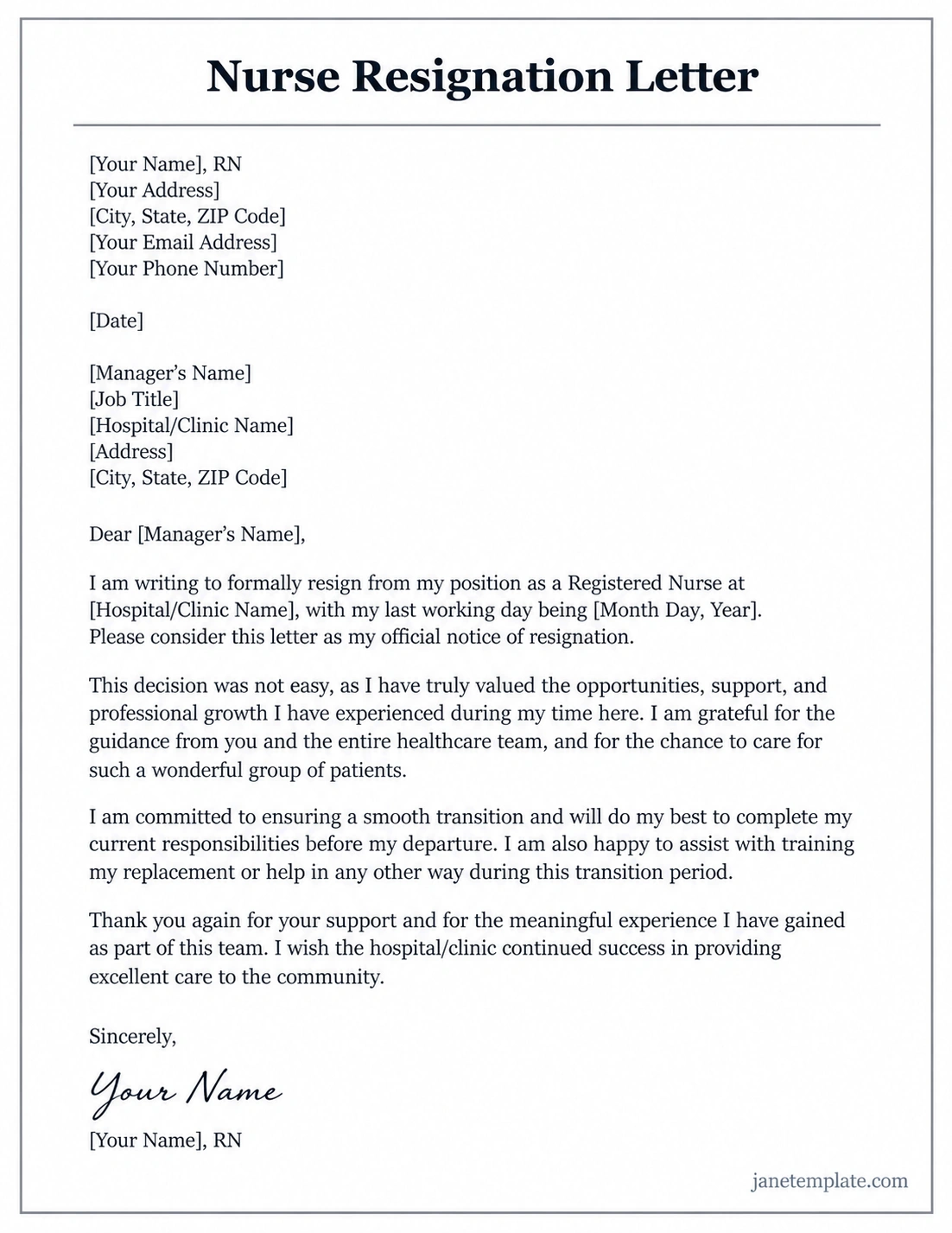
Use the following sample as editable text when preparing your own letter.
[Your Name], [RN/LPN/LVN]
[Your Address]
[City, State, ZIP Code]
[Your Email Address]
[Your Phone Number]
[Date]
[Manager’s Name]
[Manager’s Job Title]
[Hospital or Clinic Name]
[Address]
Dear [Manager’s Name],
Please accept this letter as formal notice of my resignation from my position as [Nursing Position] at [Hospital or Clinic Name]. My intended last working day will be [Month Day, Year], subject to any applicable notice requirements and confirmation with the organization.
I appreciate the opportunities, experience, and professional development I have gained during my time with the organization. Thank you for your guidance and for the opportunity to contribute to the healthcare team.
I will make reasonable efforts to support an orderly transition before my departure, including completing appropriate documentation and coordinating outstanding responsibilities in accordance with workplace procedures.
Thank you for your understanding. I wish you and the team continued success in providing quality patient care.
Sincerely,
[Your Name], [RN/LPN/LVN]
How to Write a Nurse Resignation Letter Step by Step
Writing a resignation letter becomes easier when you focus on the essential information and maintain a professional tone.
Review Your Notice Requirements
Before writing the letter, check your employment agreement, organizational policies, and applicable requirements. Notice periods can vary according to the position, employer, contract, and jurisdiction.
Do not assume that every nursing position requires the same notice period. If you have questions, contact human resources or seek appropriate employment advice.
Choose a Clear and Respectful Tone
Use straightforward language and avoid unnecessary explanations. You do not need to describe every reason for leaving or discuss workplace disagreements in detail.
If you are resigning because of a difficult situation, consider keeping the formal letter focused on your departure. More detailed feedback may be better addressed through an appropriate exit interview or separate communication.
Confirm Your Last Working Day
Make sure the proposed final working day is accurate and consistent with the notice arrangements agreed upon with your employer. If the date is not yet confirmed, clarify it with your manager or human resources department.
Offer Appropriate Transition Assistance
Where practical, offer to help organize relevant documentation, communicate outstanding work, and complete appropriate handover tasks. Follow workplace procedures for patient records, confidential information, and clinical responsibilities.
Proofread Before Submitting
Check the spelling of names, job titles, dates, and the healthcare facility’s name. Ensure that the resignation statement is clear and that the final working day is easy to identify.
Save a copy of the final letter and use the submission method required by your employer.
Nurse Resignation Letter Examples for Different Situations
The right wording depends on your circumstances. These examples illustrate how to adjust a resignation letter while maintaining a professional tone.
Registered Nurse Resignation Letter
Example: “Please accept this letter as formal notice of my resignation from my Registered Nurse position at [Hospital Name], effective [Last Working Day]. I appreciate the experience and professional opportunities I have received and will assist with an orderly transition in accordance with department procedures.”
This version is suitable for an RN leaving a hospital, outpatient facility, or other healthcare organization.
Staff Nurse Resignation Letter
Example: “I am writing to resign from my Staff Nurse position at [Facility Name]. My intended final working day is [Date]. Thank you for the support and experience I have gained while working with the nursing team.”
Keep the letter concise and include any additional details required by your employer.
Nurse Resignation Letter for a New Job
Example: “I have decided to accept a new professional opportunity and am submitting my resignation from my position as [Nursing Position]. My last working day will be [Date]. I am grateful for my experience with the organization and will do my best to support a smooth transition.”
You generally do not need to disclose the name of your new employer unless there is a specific reason to do so.
Nurse Resignation Letter for Personal Reasons
Example: “I am writing to formally resign from my position as [Nursing Position] at [Facility Name] for personal reasons. My intended last working day is [Date]. Thank you for your understanding and for the opportunities I have received during my employment.”
This wording communicates the decision without requiring you to disclose private details.
Nurse Resignation Letter With Short Notice
Example: “I am writing to submit my resignation from my position as [Nursing Position], with a proposed final working day of [Date]. I understand that this provides less notice than may normally be expected, and I apologize for the inconvenience. I would appreciate the opportunity to discuss the transition arrangements with you.”
When shorter notice is necessary, communicate promptly and discuss the situation with your manager or human resources department. Follow applicable contractual and workplace requirements, and do not promise transition arrangements that you cannot reasonably fulfill.
Common Mistakes to Avoid
Avoid these mistakes when preparing a professional nursing resignation letter.
- Leaving out the final working day: State your proposed last day clearly and confirm the date with your employer.
- Writing an emotional or hostile letter: Keep criticism and personal disputes out of the formal resignation notice.
- Providing unnecessary personal details: A brief explanation is usually sufficient if you choose to give one.
- Making unrealistic transition promises: Offer only assistance that is practical and consistent with your responsibilities.
- Ignoring workplace procedures: Follow the organization’s resignation, handover, and documentation requirements.
- Forgetting to keep a copy: Retain the submitted letter and any acknowledgment for your records.
What to Do After Submitting Your Resignation
Submitting a nurse resignation letter is only one part of leaving a healthcare position. A few follow-up steps can help make the transition more organized.
- Confirm receipt: Ask your manager or human resources department to acknowledge the letter when appropriate.
- Clarify the final date: Confirm your final working day and any relevant scheduling arrangements.
- Coordinate clinical handover: Follow established procedures for transferring patient care responsibilities.
- Complete required documentation: Finalize records and administrative tasks within your role and access permissions.
- Return organizational property: Follow instructions for returning badges, keys, equipment, and other items.
- Review employment administration: Ask human resources about final pay, benefits, unused leave, and any required exit procedures.
Maintain patient confidentiality throughout the transition. Do not copy or retain patient records for personal use, and use only approved systems and procedures when completing handover documentation.
Frequently Asked Questions About Nurse Resignation Letters
What should a nurse resignation letter include?
A nurse resignation letter should include a clear resignation statement, your nursing position, the employer’s name, your intended last working day, and a professional closing. You may also include appreciation and an offer to assist with the transition.
How much notice should a nurse give when resigning?
The appropriate notice period depends on your employment agreement, workplace policies, applicable laws, and circumstances. Review these requirements and confirm the arrangements with your manager or human resources department.
Does a nurse resignation letter need to include a reason for leaving?
Usually, a detailed explanation is not necessary unless your employer requires specific information. You can simply state that you are resigning or briefly mention a new opportunity or personal reasons.
Can a nurse resign immediately?
Immediate resignation may be possible in some circumstances, but the consequences depend on the applicable agreement, workplace policies, and local requirements. Contact human resources or seek appropriate advice if you need to leave before the usual notice period.
Should a nurse resignation letter be emailed or printed?
Either method may be appropriate. Follow your employer’s submission procedure and use a professional format. If you send the letter by email, include a clear subject line and retain a copy of the message.
Should I thank my manager in the resignation letter?
Thanking your manager is optional, but a brief, sincere expression of appreciation can help maintain a professional relationship. Keep the wording appropriate to your actual experience.
Can I use a nurse resignation letter template?
Yes. A template provides a convenient structure for organizing the resignation statement, final working day, appreciation, and closing. Customize the details so the letter accurately reflects your role and circumstances.
How long should a nurse resignation letter be?
Most resignation letters can be completed in a few concise paragraphs. Focus on the formal notice, final working day, and any relevant transition arrangements rather than including unnecessary details.
Conclusion
A nurse resignation letter is an important professional document that communicates your decision to leave a nursing position and records your intended final working day. A clear, respectful letter can support employment administration, preserve professional relationships, and help the healthcare team plan an orderly transition.
Use a nurse resignation letter template to organize the essential details, review your notice requirements, and adapt the wording to your circumstances. Before submitting the letter, verify the dates, follow workplace procedures, and prepare to complete appropriate handover responsibilities.
By keeping your resignation letter professional and concise, you can close your current employment chapter respectfully while preparing for the next stage of your nursing career.
Download: Nurse Resignation Letter Template
