A mortgage amortization schedule shows how each mortgage payment is divided between principal and interest over the life of a home loan. It helps you see how your loan balance changes, how much interest you will pay, and how quickly you build equity in your home.
Understanding an amortization schedule can make a mortgage easier to manage. Instead of looking only at your monthly payment, you can see exactly where your money goes during every payment period.
Whether you are buying a home, refinancing an existing mortgage, or planning to pay off your loan early, a mortgage amortization schedule can be a useful financial planning tool.
What Is a Mortgage Amortization Schedule?
A mortgage amortization schedule is a detailed table that lists the payments required to repay a mortgage over a specific loan term. It typically shows the payment number, payment date, payment amount, principal paid, interest paid, and remaining loan balance.
At the beginning of a typical amortizing mortgage, a larger portion of each payment goes toward interest. As the loan balance decreases, more of each payment is generally applied to principal.
A complete amortization schedule can help you answer questions such as:
- How much will my monthly mortgage payment be?
- How much interest will I pay over the entire loan?
- How much principal will I repay each year?
- When will I reach a specific loan balance?
- How quickly will I build home equity?
- How could additional principal payments affect the loan?
Mortgage Amortization Schedule Template
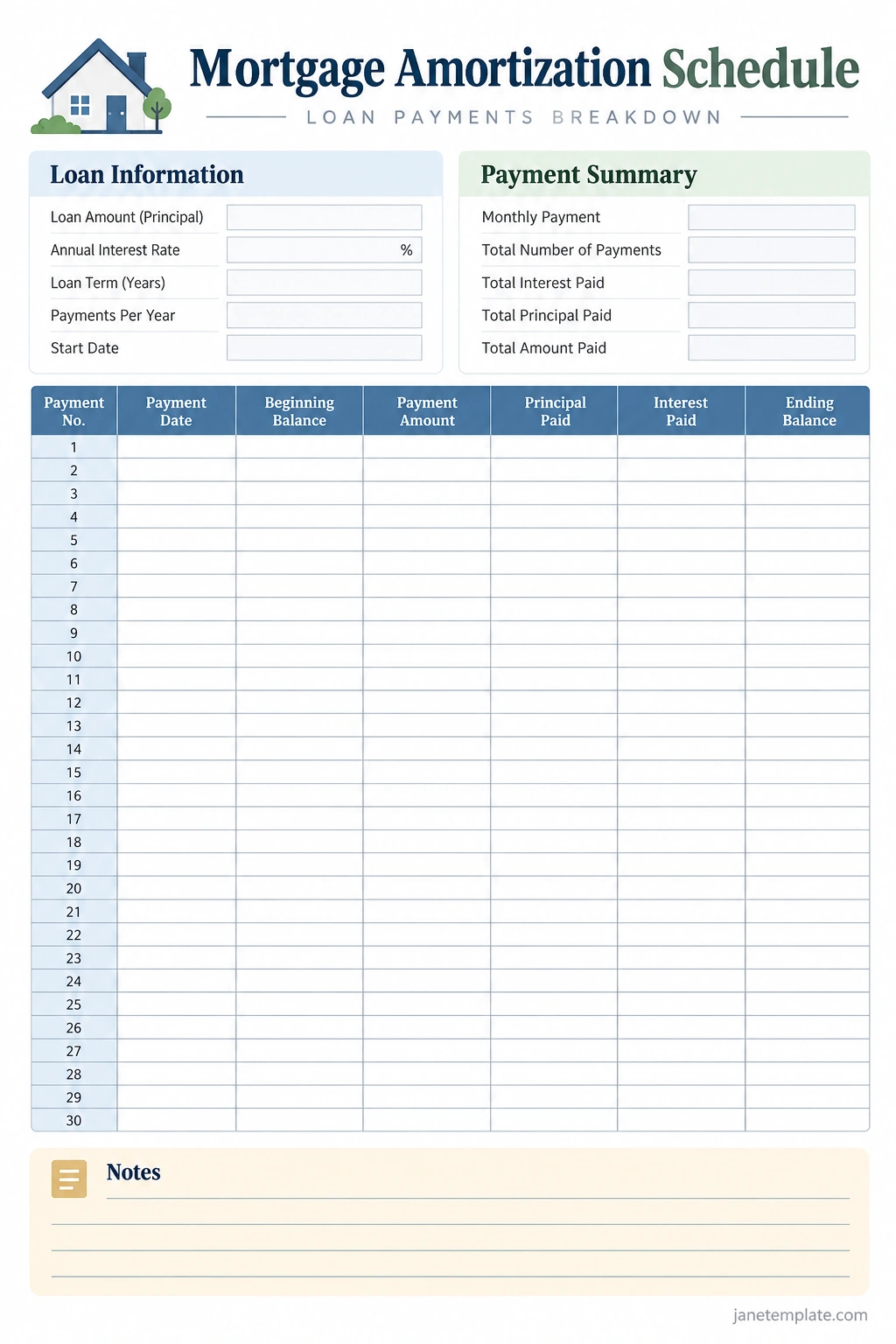
A printable mortgage amortization schedule template can help you organize loan information and track payments in one place. You can record the original loan amount, interest rate, loan term, payment frequency, and payment details.
The template below includes columns for the payment number, payment date, beginning balance, payment amount, principal paid, interest paid, and ending balance.
How Does Mortgage Amortization Work?
Mortgage amortization is the process of gradually paying off a loan through scheduled payments. Each payment normally includes both principal and interest.
The principal is the amount borrowed to purchase the home. The interest is the cost of borrowing that money. With a fully amortizing fixed-rate mortgage, scheduled payments are designed to pay the loan balance down to zero by the end of the agreed loan term, assuming payments are made as scheduled.
Principal Payment
The principal portion of a payment reduces the amount you owe. For example, if your mortgage balance is $300,000 and $500 of a payment is applied to principal, the balance becomes $299,500 before considering any other adjustments.
Interest Payment
The interest portion represents the borrowing cost for the payment period. For many mortgages, interest is calculated based on the outstanding principal balance.
As the principal balance decreases, the amount of interest charged during each period can also decrease. This allows a larger portion of a fixed scheduled payment to go toward principal over time.
What Information Is Included in an Amortization Schedule?
A mortgage payment schedule can contain several important columns. Understanding each one makes the table much easier to read.
Payment Number
This identifies the payment sequence, such as payment 1, payment 2, payment 3, and so on.
Payment Date
The payment date shows when each scheduled mortgage payment is due or recorded, depending on the schedule format.
Beginning Balance
The beginning balance is the mortgage principal outstanding at the start of a payment period.
Payment Amount
This is the scheduled amount applied to the mortgage for that payment period. Depending on the loan, the amount shown in a principal-and-interest amortization schedule may not include items such as property taxes, homeowners insurance, or other escrow amounts.
Principal Paid
This portion of the payment reduces the outstanding loan principal.
Interest Paid
This portion represents interest charged for the payment period.
Ending Balance
The ending balance shows the remaining principal after the scheduled principal payment has been applied.
How to Calculate a Mortgage Payment
For a standard fixed-rate mortgage with monthly payments, the principal-and-interest payment can be calculated using the loan amount, periodic interest rate, and total number of payments.
The commonly used formula is:
M = P × [r(1 + r)n] / [(1 + r)n − 1]
In this formula, M represents the monthly principal-and-interest payment, P represents the original loan principal, r represents the monthly interest rate, and n represents the total number of monthly payments.
For example, a 30-year mortgage with monthly payments has 360 scheduled payments. The interest rate must be converted to the appropriate periodic rate before using the formula.
Actual mortgage calculations can vary depending on loan terms, payment frequency, fees, rounding, and lender practices. For an actual loan, use the figures provided by your lender or loan servicer.
Example of a Mortgage Amortization Schedule
Consider a hypothetical fixed-rate mortgage with an original principal balance of $300,000 and a 30-year term. The first payment will include both principal and interest.
Early in the loan, the outstanding balance is relatively high, so the interest portion can represent a substantial part of the scheduled payment. After many payments have reduced the principal balance, the interest portion generally becomes smaller while the principal portion becomes larger.
A simplified schedule might look like this:
- Payment 1: Beginning balance, scheduled payment, principal paid, interest paid, and ending balance are recorded.
- Payment 2: The new beginning balance reflects the previous principal payment.
- Payment 3: Interest is calculated based on the applicable outstanding balance.
- Later payments: The balance gradually declines as principal is repaid.
- Final payment: The remaining principal is paid, subject to the loan’s actual terms and rounding.
The exact numbers depend on the mortgage amount, interest rate, loan term, and payment structure.
Why Use a Mortgage Amortization Schedule?
An amortization schedule provides more information than simply knowing your monthly mortgage payment. It gives you a long-term view of how the loan changes over time.
Understand the Total Cost of the Mortgage
By adding the interest amounts across the schedule, you can estimate the total interest paid over the scheduled loan term, assuming the loan remains outstanding according to its original terms.
Track Your Remaining Balance
The schedule shows how much principal remains after each payment. This can help when reviewing your long-term financial plans.
Understand Home Equity Growth
As mortgage principal is repaid, the amount owed on the loan decreases. If the home’s value remains unchanged, the difference between the property value and mortgage balance represents equity attributable to ownership, subject to other liens or obligations.
Evaluate Additional Principal Payments
An amortization schedule can help you understand the potential effect of paying additional amounts toward principal. Depending on the mortgage terms, additional principal payments may reduce the balance faster and potentially reduce future interest charges.
Mortgage Amortization and Extra Payments
Some homeowners choose to make extra principal payments in addition to their scheduled mortgage payments. The potential benefit depends on the loan terms and how the extra payment is applied.
Examples of additional payment strategies include:
- Making one extra principal payment each year
- Adding a fixed amount to the monthly payment
- Applying occasional lump-sum payments to principal
- Increasing payments when income increases
Before making extra payments, check your mortgage documents and confirm how your lender applies additional funds. Also review whether your loan has any applicable prepayment restrictions or penalties.
How to Read a Mortgage Amortization Schedule
Reading an amortization table is straightforward once you understand the main columns.
Start With the Beginning Balance
Look at the beginning balance for a particular payment. This represents the principal outstanding before that payment is applied.
Compare Principal and Interest
Next, compare the principal and interest columns. This shows how the scheduled payment is divided between reducing the loan balance and paying the cost of borrowing.
Check the Ending Balance
Subtracting the principal paid from the beginning principal balance generally produces the ending principal balance, subject to rounding and the specific calculation method used by the lender.
Review the Schedule Over Several Years
Looking at one payment provides only a small part of the picture. Reviewing the schedule across several years makes it easier to see how the loan balance and interest allocation change over time.
Mortgage Amortization Schedule vs. Mortgage Payment
A mortgage payment and an amortization schedule are not the same thing.
A mortgage payment tells you the amount scheduled for a particular payment period. A mortgage amortization schedule shows how payments are allocated and how the loan balance changes throughout the repayment period.
This distinction is important when planning long-term housing costs because the monthly payment alone does not show how much of the loan has been repaid or how much interest will be paid over the full term.
Tips for Using a Mortgage Amortization Schedule
- Keep a copy of your original loan terms for comparison.
- Review the interest rate and loan term carefully.
- Check whether the schedule includes only principal and interest or additional costs.
- Compare the beginning and ending balances for each payment period.
- Track extra principal payments separately.
- Review the schedule before making major refinancing or payoff decisions.
- Confirm calculations with your lender or loan servicer when exact figures are important.
Frequently Asked Questions About Mortgage Amortization Schedules
What is a mortgage amortization schedule?
A mortgage amortization schedule is a table showing how each scheduled mortgage payment is divided between principal and interest and how the outstanding loan balance changes over time.
How do I get a mortgage amortization schedule?
You can often obtain an amortization schedule from your lender or loan servicer. You can also create one using a mortgage calculator, spreadsheet, or printable mortgage amortization schedule template.
Does a mortgage amortization schedule include property taxes?
Not necessarily. A standard amortization schedule generally focuses on the principal and interest components of the loan. Property taxes, homeowners insurance, mortgage insurance, and other costs may be handled separately or through an escrow account.
Why does more of my mortgage payment go toward interest at first?
Interest is generally calculated based on the outstanding principal balance. At the beginning of the mortgage, the balance is highest, so the interest portion can represent a larger share of the scheduled payment.
Does making extra mortgage payments reduce interest?
Additional principal payments can reduce the outstanding balance faster, which may reduce future interest under many loan structures. The actual savings depend on the mortgage terms, timing, and how the lender applies the additional payment.
How many payments are in a 30-year mortgage?
A standard 30-year mortgage with monthly payments has 360 scheduled payments. The actual number of payments can differ if the loan has a different payment frequency, term, or structure.
What is the difference between amortization and loan term?
Amortization describes how the loan balance is scheduled to be repaid over time. The loan term is the period covered by the mortgage agreement. These periods can be the same or different depending on the type of mortgage.
Conclusion
A mortgage amortization schedule gives you a clear view of how a home loan is repaid over time. By showing principal, interest, payment amounts, and the remaining balance, it can help you understand the cost of borrowing and track your progress toward paying off the mortgage.
Use an amortization schedule to review your loan, monitor your balance, understand interest costs, and explore how potential extra payments could affect your repayment plan. For exact figures and decisions involving your actual mortgage, always compare the schedule with the terms provided by your lender or loan servicer.
Download: Mortgage Amortization Schedule Template
