A mental status exam, commonly abbreviated as MSE, is a structured clinical assessment used to describe a person’s current mental functioning. It examines areas such as appearance, behavior, speech, mood, affect, thought processes, thought content, perception, cognition, insight, and judgment.
Healthcare professionals may use a mental status examination as part of an overall clinical assessment when evaluating mental health concerns, cognitive changes, behavioral changes, or neurological conditions that may affect thinking and behavior. The examination provides a structured snapshot of how a person is functioning at the time of the assessment.
Unlike a laboratory test that produces a numerical result, an MSE relies largely on observation, conversation, clinical questions, and the professional’s documentation of relevant findings. It can therefore provide useful information that complements the patient’s history, physical examination, medical records, and other assessments.
What Is a Mental Status Exam?
A mental status exam is a systematic assessment of a person’s current psychological and cognitive functioning. It is generally performed through clinical observation and interaction rather than through a single standardized test.
The assessment can help a clinician document how a person presents during an encounter. For example, the clinician may observe whether the person appears appropriately dressed, communicates clearly, remains attentive, demonstrates organized thinking, and is oriented to relevant aspects of their environment.
The MSE describes the person’s presentation at a particular point in time. Findings can change depending on circumstances, medical conditions, medications, substances, stress, sleep, and other factors.
Why Is a Mental Status Exam Important?
The mental status exam provides a structured framework for documenting observations that might otherwise be recorded inconsistently. It can help clinicians identify areas that require further evaluation and establish a baseline for later comparison.
An MSE may be useful for:
- Documenting a patient’s current mental functioning.
- Identifying changes in cognition or behavior.
- Supporting a broader psychiatric or medical assessment.
- Establishing a baseline for future assessments.
- Monitoring changes during treatment or follow-up.
- Communicating relevant observations among healthcare professionals.
- Identifying findings that may require additional assessment.
The MSE is one component of a broader clinical evaluation and should be interpreted together with other relevant information.
Components of a Mental Status Exam
A mental status examination typically covers several domains. The exact structure can vary depending on the clinical setting, purpose of the assessment, and professional performing it.
Appearance
Appearance describes observable characteristics such as grooming, hygiene, clothing, posture, and general physical presentation.
The clinician may document whether the person’s appearance is appropriate for the setting and circumstances. Specific observations are generally more useful than vague descriptions.
Behavior and Psychomotor Activity
This section describes how the person behaves and interacts during the assessment. The clinician may observe cooperation, eye contact, activity level, agitation, restlessness, withdrawal, or unusual movements.
Psychomotor activity can include observations about whether movements appear slowed, increased, repetitive, or otherwise unusual.
Speech
Speech can provide information about communication and certain aspects of mental functioning. The clinician may document rate, rhythm, volume, tone, fluency, and clarity.
For example, speech may be described as rapid, slow, pressured, quiet, loud, or difficult to understand when those characteristics are clinically relevant.
Mood
Mood refers to the person’s reported or described emotional state. The clinician may ask the person how they have been feeling and document their response using appropriate clinical terminology.
Common descriptions may include euthymic, anxious, sad, irritable, or elevated, depending on what the person reports and what is clinically observed.
Affect
Affect describes the observable expression of emotion during the assessment. Clinicians may consider the range, intensity, stability, and appropriateness of emotional expression.
Affect and mood are related but are not identical. Mood generally refers to the person’s subjective emotional experience, while affect describes observable emotional expression.
Thought Process
Thought process refers to how ideas are organized and connected during communication. The clinician may assess whether the person’s responses are logical, coherent, goal-directed, tangential, circumstantial, or otherwise unusual.
This area focuses on the organization and flow of thinking rather than the specific beliefs or ideas being discussed.
Thought Content
Thought content concerns what the person is thinking about. Depending on the clinical situation, assessment may include unusual beliefs, obsessive thoughts, preoccupations, or thoughts related to self-harm or harm to others.
When safety concerns are present, qualified professionals should conduct an appropriate risk assessment rather than relying on a checklist alone.
Perception
Perception refers to how a person experiences sensory information. The clinician may ask about unusual perceptual experiences and document relevant observations.
Depending on the assessment, this may include visual, auditory, tactile, olfactory, or gustatory experiences that the person reports as unusual.
Cognition
Cognition includes several mental processes involved in attention, memory, orientation, language, and other aspects of thinking.
A clinician may assess areas such as:
- Orientation to person, place, time, or situation.
- Attention and concentration.
- Immediate or recent memory.
- Language.
- General knowledge or fund of knowledge.
- Ability to follow instructions.
The depth of cognitive assessment depends on the purpose of the encounter. A brief MSE is not necessarily equivalent to a comprehensive neuropsychological or cognitive evaluation.
Insight
Insight generally refers to a person’s awareness or understanding of their condition, experiences, or circumstances. Documentation should be based on the person’s statements and clinical observations rather than assumptions.
Judgment
Judgment concerns decision-making and the person’s ability to evaluate situations and respond appropriately. Clinicians may assess judgment through conversation, hypothetical situations, history, and observed behavior when relevant.
How Is a Mental Status Exam Performed?
The MSE is generally incorporated into a clinical encounter rather than performed as a completely separate procedure. Information can be gathered through observation, conversation, questions, and review of relevant clinical information.
Observe the Patient’s Presentation
Observation begins as the clinician interacts with the patient. Appearance, behavior, speech, attention, and emotional expression may provide information relevant to the assessment.
Ask Appropriate Questions
Questions should be appropriate to the person’s situation and the purpose of the assessment. Simple questions may provide information about orientation, mood, thought content, memory, and other cognitive domains.
Document Objective Findings
Clinical documentation should distinguish observations from assumptions. Describing specific behaviors or statements can make the record clearer than using unsupported interpretations.
Consider the Clinical Context
MSE findings should be interpreted within the broader clinical context. Medical conditions, medications, substances, language differences, cultural factors, developmental factors, sensory impairments, and environmental circumstances can influence presentation.
Mental Status Exam vs. Psychiatric Evaluation
A mental status exam is not the same as a complete psychiatric evaluation. The MSE focuses primarily on the person’s current mental functioning and presentation during the encounter.
A comprehensive psychiatric evaluation may include a much broader range of information, such as presenting concerns, psychiatric history, medical history, medications, substance use, family history, social history, trauma history, risk assessment, and other clinically relevant information.
The MSE therefore works as one component of a larger assessment rather than a complete diagnostic process by itself.
Example Mental Status Exam Documentation
A clinical note may summarize findings across the relevant domains rather than simply checking boxes. The exact wording should reflect what was actually observed or reported.
For example, documentation might describe a patient as appropriately groomed, cooperative during the encounter, speaking at a normal rate and volume, reporting an anxious mood, demonstrating an affect consistent with the discussion, and displaying organized and goal-directed thought processes.
The clinician can then document relevant cognitive findings, insight, judgment, and any additional observations that are important to the clinical assessment.
Using a Mental Status Exam Template
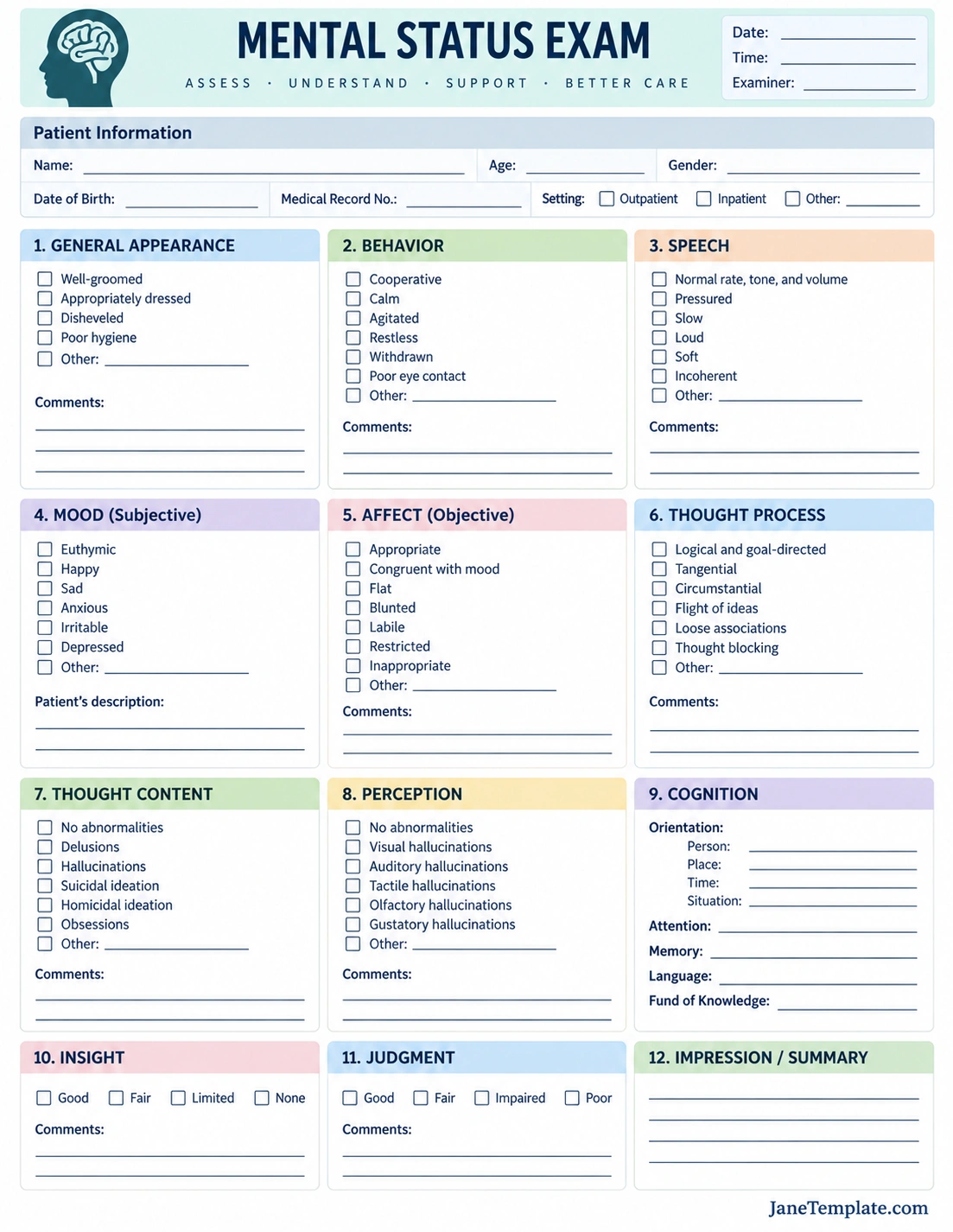
A mental status exam template can provide a structured framework for documenting common assessment domains. A printable form may include separate sections for appearance, behavior, speech, mood, affect, thought process, thought content, perception, cognition, insight, judgment, and an overall impression or summary.
Templates can help organize documentation, but they should be adapted to the clinical setting and the purpose of the assessment. A checklist should not replace clinical judgment or a comprehensive assessment when one is needed.
Benefits of a Printable Mental Status Exam Worksheet
A printable MSE worksheet can be useful when a clinician prefers a structured paper-based documentation format or needs a quick reference during an assessment.
- Provides a consistent structure for common MSE domains.
- Helps organize observations in one place.
- Provides space for comments and clinical notes.
- Can be adapted to different assessment settings.
- Can support consistent documentation practices.
- Provides a convenient reference during an assessment.
Any clinical form should be used in accordance with applicable professional, institutional, privacy, and documentation requirements.
Common Mistakes When Documenting an MSE
Using Vague Descriptions
Descriptions such as “normal” may provide less useful information than a concise description of what was actually observed. When clinically appropriate, document specific findings.
Confusing Mood and Affect
Mood and affect are related but represent different aspects of emotional functioning. Keeping the two concepts distinct can make documentation more precise.
Overlooking Context
A patient’s presentation can be affected by many factors. A finding should be interpreted in the context of the person’s history, environment, medical status, and reason for evaluation.
Treating the Template as a Diagnostic Tool
A checklist or worksheet organizes observations, but it does not independently establish a diagnosis. Diagnosis requires appropriate clinical assessment and interpretation by a qualified professional.
Tips for Completing a Mental Status Exam
- Use a structured approach so important domains are not overlooked.
- Document relevant observations clearly and concisely.
- Separate the patient’s reported experience from the clinician’s observations.
- Use clinically appropriate terminology.
- Consider cultural, linguistic, developmental, and medical factors.
- Document significant changes from previous assessments when relevant.
- Include additional notes when a standard checkbox does not adequately describe the presentation.
- Follow applicable clinical documentation and privacy requirements.
When Is a Mental Status Exam Used?
A mental status examination may be used in many clinical settings, including psychiatric evaluations, primary care, emergency care, inpatient settings, outpatient mental health services, neurological assessments, and other healthcare environments where mental functioning is relevant.
The depth of the examination can vary considerably. A brief assessment may be appropriate for routine documentation, while a more detailed evaluation may be necessary when significant changes in mental functioning or safety concerns are present.
Final Thoughts
A mental status exam is a structured way for qualified healthcare professionals to document a person’s current mental and cognitive functioning. By covering areas such as appearance, behavior, speech, mood, affect, thought process, thought content, perception, cognition, insight, and judgment, the MSE provides a useful snapshot of the patient’s presentation during an encounter.
A printable mental status exam template can make the documentation process more organized by providing clearly labeled sections and space for clinical observations. However, the form should be considered a documentation aid rather than a substitute for professional assessment, clinical judgment, or appropriate diagnostic procedures.
When used appropriately and interpreted alongside the patient’s history, examination, and other relevant information, the mental status exam can be an important part of understanding and documenting changes in mental functioning.
Download: Mental Status Exam Template
