Planning a trip can be exciting, but paying for airfare all at once can put pressure on your travel budget. A Plane Ticket Payment Plan worksheet helps you organize installment payments, track due dates, and monitor how much you still need to pay for your flight tickets.
Instead of trying to remember multiple payment dates or calculate your remaining balance repeatedly, you can use a simple payment tracker to keep everything organized. This is especially helpful when you are saving for an upcoming vacation, planning a family trip, or arranging airfare for a group.
In this guide, you will learn how a plane ticket payment plan works, what information to include in a payment worksheet, and how to create a realistic installment schedule. You will also find a printable Plane Ticket Payment Plan Template that you can use to track your airfare payments and stay on top of your travel budget.
What Is a Plane Ticket Payment Plan?
A Plane Ticket Payment Plan is a payment arrangement or budgeting schedule that allows travelers to organize the cost of airfare into smaller payments over a specific period rather than paying the entire amount upfront.
Depending on the airline, travel agency, or booking platform, eligible travelers may be able to use installment options, buy now, pay later services, or other approved payment arrangements. However, not every airline offers payment plans, and availability depends on the provider, destination, booking conditions, and payment method.
A plane ticket payment plan worksheet is a separate planning tool. It helps you record the total ticket price, initial payment, remaining balance, installment amounts, and payment due dates. You can use it whether you have an official installment agreement or are simply saving money toward a future flight purchase.
A typical airfare payment tracker includes:
- Destination and travel dates.
- Airline and booking information.
- Total plane ticket price.
- Down payment or initial payment.
- Remaining balance.
- Number of planned installments.
- Payment amounts and due dates.
- Payment status and outstanding balance.
Why Use a Plane Ticket Payment Plan Worksheet?
Managing airfare payments can become confusing when you have multiple installments or are planning a trip several months in advance. A printable payment plan worksheet provides a simple way to monitor your progress and avoid missing important payment dates.
Here are some benefits of using an airfare payment tracker:
- Organizes payment schedules: Record every installment and its corresponding due date in one place.
- Tracks outstanding balances: See how much you have paid and how much remains before the ticket is fully paid.
- Supports travel budgeting: Plan your airfare expenses alongside accommodation, transportation, and other travel costs.
- Helps prevent missed payments: Keep upcoming payment deadlines visible so you can prepare in advance.
- Monitors payment progress: Track your progress toward completing the full ticket payment.
- Improves financial organization: Keep booking details, payment records, and travel information together.
Whether you are planning a short vacation or an international trip, having a clear payment schedule can make airfare budgeting easier to manage.
What Should a Plane Ticket Payment Plan Include?
A useful plane ticket payment worksheet should contain several sections that help you organize travel information and monitor each installment. The following components make the tracker practical and easy to use.
1. Trip Details
The trip details section records the basic information about your flight. This helps you identify which booking the payment schedule belongs to, especially if you are organizing multiple trips.
Include the following details:
- Destination or travel route.
- Departure and return dates.
- Airline name.
- Flight number, if available.
- Booking reference, if applicable.
2. Ticket Cost Summary
This section provides an overview of the total airfare cost and the amount you need to pay. Recording these figures makes it easier to calculate your outstanding balance.
Important fields include:
- Total Ticket Price: The full cost of the plane ticket.
- Down Payment: The initial amount paid, if required.
- Remaining Balance: The amount still owed or needed to reach your savings goal.
- Number of Installments: The planned number of payments.
- Installment Amount: The amount allocated to each payment.
3. Payment Schedule
The payment schedule is the main part of a plane ticket payment tracker. It allows you to record each installment, payment deadline, and remaining balance.
A practical payment schedule should include:
- Installment number.
- Payment due date.
- Scheduled payment amount.
- Amount actually paid.
- Remaining balance.
- Payment status.
After making a payment, update the amount paid and mark the installment as completed. This helps you maintain an accurate record of your airfare payments.
4. Notes Section
Use the notes section to record additional payment information, such as transaction references, confirmation numbers, changes to the payment schedule, or special booking conditions.
5. Goal and Progress
This section helps you monitor your progress toward paying the full ticket price. Record your target completion date and update the payment progress whenever you make a payment.
You can calculate your payment progress using this formula:
Payment Progress = (Total Amount Paid ÷ Total Ticket Price) × 100
For example, if your plane ticket costs $800 and you have paid $400, your payment progress is 50%.
Free Plane Ticket Payment Plan Template
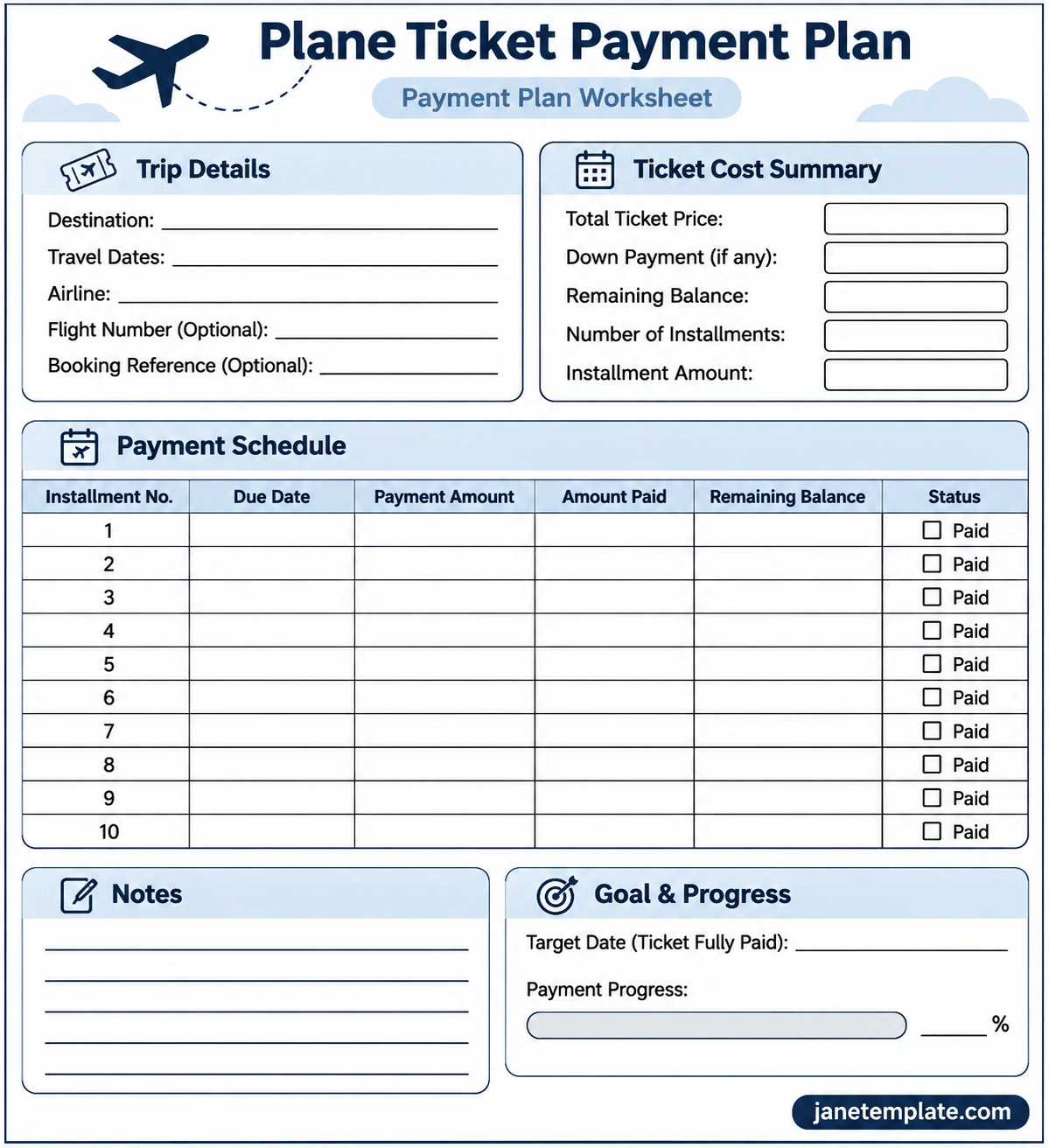
If you want a simple way to organize your airfare installments, this printable Plane Ticket Payment Plan Template can help. It provides dedicated spaces for trip details, ticket costs, installment schedules, payment status, and progress tracking.
You can print the worksheet and fill it out by hand or use it as a reference when maintaining your digital travel budget. The layout is designed to keep important payment information organized on a single page.
Use this worksheet to:
- Record your flight information and destination.
- Calculate your total ticket cost and remaining balance.
- Organize up to ten installment payments.
- Track payment dates and completed installments.
- Monitor your progress toward your airfare payment goal.
How to Create a Plane Ticket Payment Plan
Creating an airfare payment schedule is straightforward when you know the total ticket price and how much you can afford to pay regularly. Follow these steps to build a payment plan that fits your travel budget.
Step 1: Determine the Total Ticket Cost
Start by researching your flight and identifying the full ticket price. Include applicable taxes, baggage fees, seat selection charges, and other booking costs if they are not already included in the displayed fare.
Use the final amount you expect to pay rather than relying only on the initial advertised ticket price.
Step 2: Check Available Payment Options
Before creating an installment schedule, check whether the airline, travel agency, or booking platform offers an approved payment plan.
Review important conditions such as:
- Minimum down payment requirements.
- Number of available installments.
- Payment deadlines.
- Interest, service fees, or other charges.
- Late payment penalties.
- Cancellation and refund conditions.
Some providers require full payment at the time of booking. If installment payments are unavailable, you can still use the worksheet as a personal savings tracker before purchasing your ticket.
Step 3: Calculate Your Installment Amount
Once you know the total ticket price and initial payment, calculate the remaining balance. Divide that amount by the number of planned installments to estimate each payment.
For example, imagine your plane ticket costs $900 and you make an initial payment of $200. Your remaining balance is $700.
If you plan to divide the remaining balance into five equal payments, the calculation is:
- Total ticket price: $900.
- Initial payment: $200.
- Remaining balance: $700.
- Number of installments: 5.
- Payment per installment: $140.
This example is a budgeting illustration, not a guarantee that an airline or booking provider will offer five installments without additional fees.
Step 4: Set Realistic Payment Due Dates
Choose payment dates that match your income schedule and leave enough time to complete the required payments before your trip or booking deadline.
If you are using an official installment service, always follow the provider’s actual payment deadlines rather than creating your own schedule.
Step 5: Record Every Payment
After making an installment, enter the actual amount paid and update your remaining balance. Keep payment receipts or confirmation emails so you can verify your records if necessary.
Step 6: Review Your Payment Progress
Check your worksheet regularly to see whether you are following your planned schedule. If your budget changes, adjust your personal savings targets while keeping any official payment agreement in mind.
Example of a Plane Ticket Installment Payment Schedule
Here is a simple example of how you can organize your airfare payments using a payment tracker.
Assume the total ticket price is $900, with a $200 initial payment and five additional installments of $140 each.
- Initial Payment: $200.
- Installment 1: $140 – Remaining balance: $560.
- Installment 2: $140 – Remaining balance: $420.
- Installment 3: $140 – Remaining balance: $280.
- Installment 4: $140 – Remaining balance: $140.
- Installment 5: $140 – Remaining balance: $0.
After completing all payments, the total amount paid will equal $900. You can use the same method for different ticket prices and payment schedules.
Tips for Managing Plane Ticket Payments
A payment worksheet is most useful when you update it consistently and combine it with a realistic travel budget. Consider these tips when managing your airfare expenses.
- Start planning early: Give yourself enough time to save for airfare before your intended departure date.
- Set a realistic budget: Choose installment or savings amounts that fit comfortably within your regular expenses.
- Check booking conditions: Understand whether your ticket is reserved, confirmed, or subject to full payment before a specific deadline.
- Include additional fees: Account for baggage, seat selection, taxes, and other possible travel charges.
- Keep payment records: Save receipts, booking confirmations, and transaction references.
- Use payment reminders: Set calendar alerts for upcoming installment deadlines.
- Maintain an emergency buffer: Avoid committing your entire travel budget to airfare payments.
Most importantly, never assume that a personal payment tracker guarantees a flight reservation. Confirm your booking and payment status directly with the airline or authorized booking provider.
Frequently Asked Questions About Plane Ticket Payment Plans
Can you pay for plane tickets in installments?
Yes, some airlines, travel agencies, and booking platforms offer installment payment options through eligible payment providers. Availability, fees, and repayment terms vary. Some bookings require full payment upfront.
What is a plane ticket payment plan worksheet?
A plane ticket payment plan worksheet is a printable or digital tracker used to organize airfare costs, installment amounts, payment due dates, and outstanding balances. It can also help travelers monitor savings progress before purchasing a ticket.
How do I calculate monthly plane ticket payments?
Subtract your initial payment from the total ticket price, then divide the remaining balance by the number of planned monthly payments. For example, a $1,000 ticket with a $200 down payment and four equal installments would require four payments of $200, excluding additional fees.
Does every airline offer payment plans?
No. Payment options vary by airline, booking platform, destination, and payment provider. Check the official booking terms before assuming that an installment option is available.
Can I use a payment plan worksheet without an installment agreement?
Yes. You can use the worksheet as a personal airfare savings tracker. Record your target ticket price, planned contributions, savings dates, and remaining amount before purchasing your flight.
What happens if I miss a plane ticket installment payment?
The consequences depend on the payment provider and booking agreement. You may face late fees, additional interest, cancellation, or other penalties. Contact the provider promptly if you expect to miss a scheduled payment.
How many installments should I use for a plane ticket?
The number of installments depends on your budget, travel date, and the payment options available. Choose a schedule that allows you to complete the required payments on time without creating unnecessary financial pressure.
Should I include baggage fees in my plane ticket payment plan?
Yes. If baggage fees, seat selection, or other charges are not included in the original airfare, record them separately or add them to your estimated total travel cost. This helps you avoid underestimating your expenses.
Conclusion
A Plane Ticket Payment Plan is a practical way to organize airfare installments and manage travel expenses over time. By recording your ticket price, initial payment, installment amounts, due dates, and remaining balance, you can keep your payment schedule clear and easy to follow.
Whether you are using an official airline installment option or saving money toward a future flight, a printable payment plan worksheet can help you stay organized and monitor your progress.
Download and use the Plane Ticket Payment Plan Template to keep your flight information and payment records in one place. With a realistic budget and consistent tracking, you can prepare for your next trip with greater financial confidence.
Download: Plane Ticket Payment Plan Template
