A student reference letter is a valuable document that helps demonstrate a student’s academic abilities, personal character, achievements, and potential. It provides an independent perspective from someone who knows the student well, such as a teacher, professor, academic advisor, or mentor. This letter can strengthen an application for college admission, scholarships, internships, employment, or other educational opportunities.
Unlike a resume or personal statement, a student reference letter describes the student from the recommender’s perspective. It highlights specific qualities, experiences, and accomplishments that help an admissions committee or prospective employer understand why the student may be a suitable candidate.
Writing an effective reference letter does not require complicated language. The most important elements are a clear recommendation, relevant examples, and an honest assessment of the student’s strengths. In this guide, you will learn what to include in a student reference letter, how to structure it, and how to prepare a professional recommendation that supports the student’s goals.
What Is a Student Reference Letter?
A student reference letter is a formal recommendation written by someone who can describe a student’s qualifications, behavior, skills, and potential. It gives decision-makers additional insight beyond the information provided in an application, transcript, or resume.
The person writing the letter should have enough direct experience with the student to provide meaningful and credible examples. A teacher might discuss academic performance and classroom participation, while a supervisor could describe workplace skills, reliability, and teamwork.
A student recommendation letter may be used for several purposes, including:
- College and university applications: Support a student’s application with evidence of academic ability and readiness for further study.
- Scholarship applications: Highlight achievement, motivation, leadership, and commitment to educational goals.
- Internships and job opportunities: Describe transferable skills, responsibility, communication, and work ethic.
- Exchange and study abroad programs: Demonstrate adaptability, maturity, and interest in learning.
- Academic awards and special programs: Explain why a student deserves consideration for a particular opportunity.
The content should match the opportunity. A letter for a research program, for example, may emphasize analytical skills and curiosity, while a recommendation for a part-time job may focus on punctuality, communication, and dependability.
Why Is a Student Reference Letter Important?
A strong student reference letter adds context to an application. Grades and certificates can show academic results, but they may not fully explain a student’s attitude, growth, or contributions to a learning environment.
Provides an Independent Perspective
A recommender can describe qualities they have personally observed. This perspective helps admissions officers or employers understand how the student approaches responsibilities, responds to challenges, and works with others.
Highlights Strengths Beyond Grades
Academic performance matters, but students may also demonstrate leadership, creativity, perseverance, communication, and problem-solving skills. A reference letter can explain these strengths through examples from class projects, extracurricular activities, volunteer work, or employment.
Supports Educational and Career Goals
A well-written recommendation connects the student’s abilities with the opportunity they are pursuing. By explaining why the student’s experience and qualities are relevant, the writer can help the reader assess the student’s suitability more clearly.
Who Can Write a Student Reference Letter?
The best recommender is someone who knows the student well and can provide specific, honest observations. The ideal person depends on the application requirements and the nature of the opportunity.
- Teacher: Can describe classroom participation, academic progress, study habits, and intellectual curiosity.
- Professor or lecturer: Can discuss advanced coursework, research ability, analytical thinking, and academic independence.
- School counselor: Can provide context about educational development, school involvement, and personal growth.
- Academic advisor: Can explain the student’s commitment, progress toward goals, and participation in academic programs.
- Internship or work supervisor: Can describe professional conduct, teamwork, initiative, and practical skills.
- Volunteer coordinator or mentor: Can provide relevant examples of responsibility, service, leadership, and cooperation.
Family members are generally less suitable for formal academic or employment recommendations unless the application specifically requests a personal character reference. Always check the recipient’s requirements before choosing a writer.
What to Include in a Student Reference Letter
A professional student reference letter should be organized, relevant, and easy to read. Although the exact format may vary, most effective letters include the following elements.
Writer’s Information
Begin with the writer’s name, professional title, institution or organization, and contact details when appropriate. This information helps the recipient understand the writer’s relationship to the student and provides a way to verify the recommendation.
Date and Recipient Details
Include the date and the recipient’s name, title, or department if known. When the recipient is not identified, a greeting such as “Dear Admissions Committee” or “Dear Hiring Manager” may be appropriate.
Introduction and Relationship to the Student
State who the student is, how you know them, and how long you have worked with or taught them. Explain the purpose of the letter and establish why you are qualified to recommend the student.
Academic Strengths and Personal Qualities
Describe the student’s most relevant strengths. These may include critical thinking, discipline, curiosity, communication, initiative, leadership, or collaboration. Select qualities that directly support the student’s application rather than listing every positive trait.
Specific Examples and Achievements
Use concrete examples to demonstrate the student’s abilities. You might mention a successful research project, a thoughtful classroom contribution, a leadership role, or an improvement in performance. Specific observations make the recommendation more credible than broad statements alone.
Clear Recommendation and Closing
Conclude with a direct statement of support. Briefly explain why you believe the student is suitable for the opportunity and offer to provide further information if appropriate. Finish with a professional closing and the writer’s name and title.
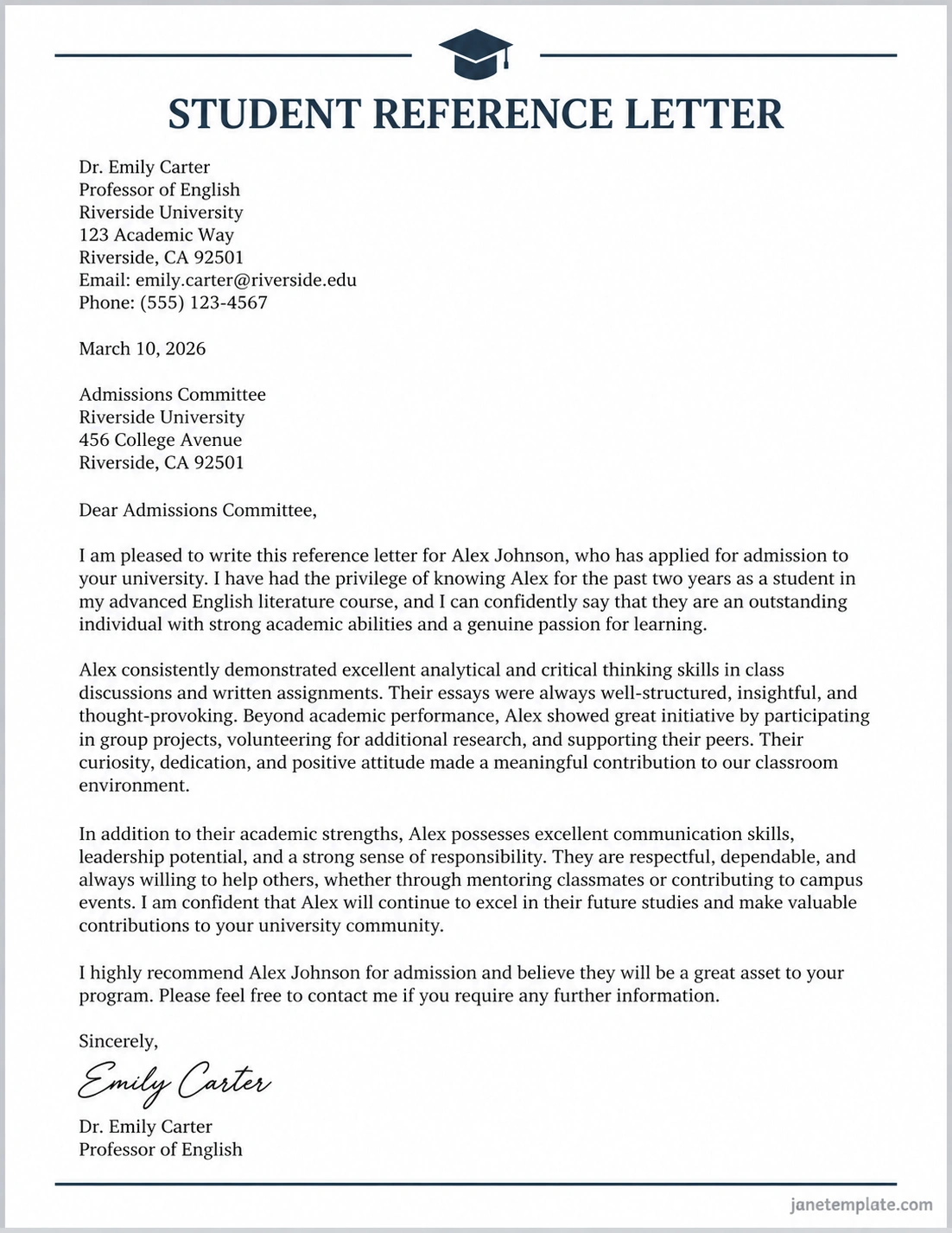
Sample Student Reference Letter
The following student reference letter example demonstrates how to organize a recommendation for a university application. Replace the sample details with accurate information and adapt the content to the student’s actual achievements.
Dr. Emily Carter
Professor of English
Riverside University
Email: [email protected]
March 10, 2026
Admissions Committee
Riverside University
Dear Admissions Committee,
I am pleased to recommend Alex Johnson for admission to your university. I have known Alex for two years as a student in my advanced English literature course and have been impressed by their academic dedication, curiosity, and willingness to engage with challenging ideas.
Alex consistently demonstrates strong analytical and critical thinking skills in classroom discussions and written assignments. Their essays are well organized, carefully researched, and supported by thoughtful interpretations of complex texts. Alex also approaches feedback constructively and uses it to improve the quality of their work.
Beyond academic performance, Alex contributes positively to group projects and supports classmates when working through difficult material. Their communication skills, reliability, and respectful attitude make them a valued member of our learning community.
I believe Alex has the motivation and academic preparation needed to succeed in further study. I recommend Alex for admission and am confident that they will contribute positively to your university community. Please contact me if you require any additional information.
Sincerely,
Dr. Emily Carter
Professor of English
Riverside University
This sample is illustrative. A real reference letter should reflect the writer’s genuine experience with the student and should not include achievements or personal qualities that cannot be supported.
How to Write an Effective Student Reference Letter
Writing a useful recommendation involves more than praising the student. Follow these steps to create a letter that is specific, professional, and relevant.
Understand the Purpose of the Application
Ask the student what they are applying for and review the relevant instructions. Identify the qualities or qualifications that matter most to the recipient. This helps you focus the letter on the student’s suitability for that particular opportunity.
Gather Accurate Information
Ask the student to provide their resume, academic achievements, application details, and submission deadline. These materials can help you recall relevant examples, but your recommendation should reflect your own observations rather than simply repeating the student’s application.
Choose Two or Three Relevant Strengths
Focus on a small number of qualities that you can demonstrate through real experiences. For example, you might describe analytical ability through a research project or reliability through consistent participation in a long-term activity.
Use a Professional and Positive Tone
Write clearly and avoid exaggerated claims. A credible letter uses confident language supported by evidence. Keep paragraphs focused, use the student’s preferred name and pronouns where appropriate, and check the spelling of names and institutions.
Proofread Before Submission
Review the letter for grammar, clarity, accuracy, and formatting. Confirm that the recipient’s details and submission instructions are correct. If the letter must be submitted through an online portal, follow the requested file format and submission process.
Common Mistakes to Avoid
Even a positive recommendation can be less effective if it lacks focus or contains unsupported claims. Avoid these common problems when preparing a student reference letter.
- Using generic praise: Replace vague statements with examples that demonstrate the student’s strengths.
- Including irrelevant details: Focus on qualities related to the opportunity rather than the student’s entire life history.
- Exaggerating achievements: Make sure every claim is honest and based on reliable information.
- Writing an overly long letter: Follow the recipient’s length requirements and remove unnecessary repetition.
- Missing the deadline: Confirm the due date early and leave time for proofreading and submission.
- Ignoring application instructions: Check whether the recipient requires a specific format, questionnaire, or direct submission.
- Sharing private information: Include only appropriate details that are relevant to the recommendation and authorized for disclosure.
Frequently Asked Questions About Student Reference Letters
What is a student reference letter used for?
A student reference letter supports applications for college, university, scholarships, internships, jobs, and educational programs. It describes the student’s abilities, character, achievements, and suitability from the perspective of someone who knows them.
Who should write a student reference letter?
A teacher, professor, academic advisor, counselor, supervisor, or mentor may write the letter, depending on the opportunity. Choose someone who knows the student well and can provide relevant, specific examples.
How long should a student reference letter be?
Unless the recipient specifies otherwise, a focused letter of approximately one page is often sufficient. Include the writer’s relationship to the student, relevant strengths, supporting examples, and a clear recommendation.
What is the difference between a reference letter and a recommendation letter?
The terms are often used interchangeably. A reference letter may emphasize a student’s character and qualifications, while a recommendation letter usually makes an explicit case for admission or selection. The intended purpose and recipient’s instructions determine the most suitable approach.
Can a student write their own reference letter?
A student can prepare a summary of achievements or a draft for a recommender to review if requested. However, the final letter should accurately represent the recommender’s own judgment, be approved by that person, and follow the recipient’s submission rules.
Should a student reference letter be printed on official letterhead?
Official letterhead can help establish the writer’s professional affiliation when the institution permits its use. If the letter is submitted electronically or the writer does not have access to letterhead, follow the recipient’s formatting instructions.
Can one student reference letter be used for multiple applications?
A general letter may be adaptable, but a tailored recommendation is often more useful. Review each opportunity’s requirements and update the letter when necessary so that its examples and recommendation match the student’s goals.
Help Students Present Their Best Qualities
A student reference letter can provide valuable insight into a student’s academic strengths, character, and potential. When written with specific examples and a clear purpose, it helps admissions committees and employers understand qualities that may not be fully visible in grades or application forms.
Choose a recommender who knows the student well, focus on relevant strengths, and use accurate examples to support the recommendation. Before submitting the letter, check the formatting, proofread every detail, and follow the recipient’s instructions. A thoughtful and professional reference can help a student present a stronger, more complete application.
Download: Student Reference Letter Template
