Paying taxes can be challenging when you owe more than you can comfortably afford at once. Whether you are an individual taxpayer, self-employed professional, or small business owner, an unexpected tax bill can put pressure on your monthly budget. Fortunately, payment plans for taxes can make managing tax debt more manageable by allowing eligible taxpayers to pay what they owe over an extended period.
In the United States, the Internal Revenue Service (IRS) offers several payment options for individuals and businesses that cannot immediately pay their federal tax balance in full. Depending on your financial situation and eligibility, you may be able to arrange a short-term payment plan or a longer monthly installment agreement.
Understanding how these arrangements work is important before choosing a payment option. You need to consider the outstanding tax balance, monthly affordability, interest, penalties, and payment deadlines. A well-organized tax payment schedule can also help you track installments and avoid missed payments.
In this guide, you will learn about payment plans for taxes, available options, eligibility requirements, application steps, and practical ways to manage tax debt. You will also find a sample tax payment plan worksheet to help organize your payment information.
What Are Payment Plans for Taxes?
Payment plans for taxes are arrangements that allow taxpayers to pay an outstanding tax balance over time instead of paying the entire amount immediately. These arrangements are commonly known as tax installment agreements or tax payment agreements.
In the United States, the IRS provides payment plans for eligible taxpayers who cannot pay their federal tax obligations in full by the original deadline. Depending on the agreement, payments may be made monthly or within a shorter repayment period.
A tax payment plan generally includes several important details:
- Total tax balance: The amount of unpaid taxes, including applicable penalties and interest.
- Payment amount: The amount the taxpayer agrees to pay during each installment period.
- Payment frequency: How often payments must be made, such as monthly.
- Payment due date: The date each installment must be received.
- Repayment period: The estimated timeframe for paying the outstanding balance.
- Payment method: The selected method for submitting payments.
These arrangements can help taxpayers manage financial obligations while working toward paying their tax debt in full.
Why Are Tax Payment Plans Important?
Having a structured payment arrangement can make tax debt easier to manage. Instead of trying to pay a large balance immediately, taxpayers can organize their finances around a more predictable payment schedule.
1. Makes Tax Debt More Manageable
A payment plan divides an outstanding tax balance into smaller installments. This can make it easier to manage monthly expenses while gradually reducing the amount owed.
2. Helps Avoid Missed Payments
A clearly defined payment schedule provides specific due dates and payment amounts. Keeping track of these details can help taxpayers avoid forgetting important deadlines.
3. Supports Better Financial Planning
Knowing how much must be paid each month makes it easier to prepare a household or business budget. Taxpayers can account for their installment obligations when planning other expenses.
4. Provides a Structured Way to Resolve Tax Debt
An approved IRS installment agreement provides an organized arrangement for paying eligible outstanding federal tax balances. It can offer a more manageable alternative to leaving an unpaid balance without a payment arrangement.
Types of Payment Plans for Taxes
The IRS offers different payment options depending on how much you owe, how quickly you can pay, and whether you meet the applicable eligibility requirements.
1. Short-Term Payment Plan
A short-term payment plan allows eligible individual taxpayers to pay their outstanding federal tax balance within 180 days or less.
This option may be suitable if you expect to have enough money to pay the full balance within a relatively short period.
Important features include:
- Generally available to eligible individuals who owe less than $100,000 in combined tax, penalties, and interest.
- Provides up to 180 days to pay the balance in full.
- Has no IRS setup fee.
- Applicable interest and late payment penalties generally continue until the balance is paid.
2. Long-Term Payment Plan (Installment Agreement)
A long-term payment plan allows eligible taxpayers to make monthly payments toward their outstanding federal tax balance. It is commonly called an IRS installment agreement.
This option may be appropriate for individuals who need more time to pay their tax debt and cannot reasonably settle the full amount within 180 days.
For individuals applying online, the general eligibility requirements include:
- Owing $50,000 or less in combined tax, penalties, and interest.
- Having filed all required tax returns.
- Being able to meet the proposed payment arrangement.
Some taxpayers may qualify for longer repayment periods. However, interest and applicable penalties generally continue to accumulate until the balance is paid in full.
3. Business Tax Payment Arrangements
Businesses that cannot pay their federal tax obligations in full may also be able to request payment arrangements from the IRS.
Business tax situations can involve additional requirements, particularly when payroll taxes are involved. Business taxpayers should contact the IRS using the number provided on their tax notice or call the business tax assistance line to discuss available options.
Sole proprietors and independent contractors generally apply as individual taxpayers for IRS payment plans.
How to Apply for Payment Plans for Taxes
Applying for an IRS payment plan involves reviewing your tax balance, checking eligibility, and selecting a payment arrangement that fits your financial situation.
Step 1: Determine Your Total Tax Balance
Start by identifying how much you owe. Review your tax return, IRS notices, and online tax account to determine the outstanding balance, including applicable penalties and interest.
Make sure you consider all relevant tax periods before deciding how much you can afford to pay.
Step 2: Review Your Financial Situation
Calculate your monthly income and necessary expenses. Determine how much money you can realistically allocate toward your tax debt without neglecting essential financial obligations.
A payment amount should be affordable and sustainable throughout the repayment period.
Step 3: Choose a Suitable Payment Plan
Compare the available payment options. If you can pay your balance within 180 days, a short-term plan may be appropriate. If you need more time, consider applying for a long-term installment agreement.
Step 4: Submit Your Application
Eligible individual taxpayers can generally apply through the IRS Online Payment Agreement application. An IRS Online Account allows taxpayers to review balances and manage available payment options.
Individuals who cannot apply online may be able to submit Form 9465, Installment Agreement Request, or contact the IRS by phone.
Step 5: Review the Agreement
After receiving a decision, carefully review the approved payment terms. Confirm the monthly amount, due date, payment method, and any applicable setup fees.
Do not assume that a proposed arrangement has been approved until you receive confirmation from the IRS.
Example of a Tax Payment Plan Worksheet
Keeping your tax information organized is an important part of managing an installment agreement. A payment plan worksheet can help you record your outstanding balance, proposed installment amount, payment frequency, and remaining balance.
The following sample illustrates a printable worksheet designed to organize tax payment information in one place.
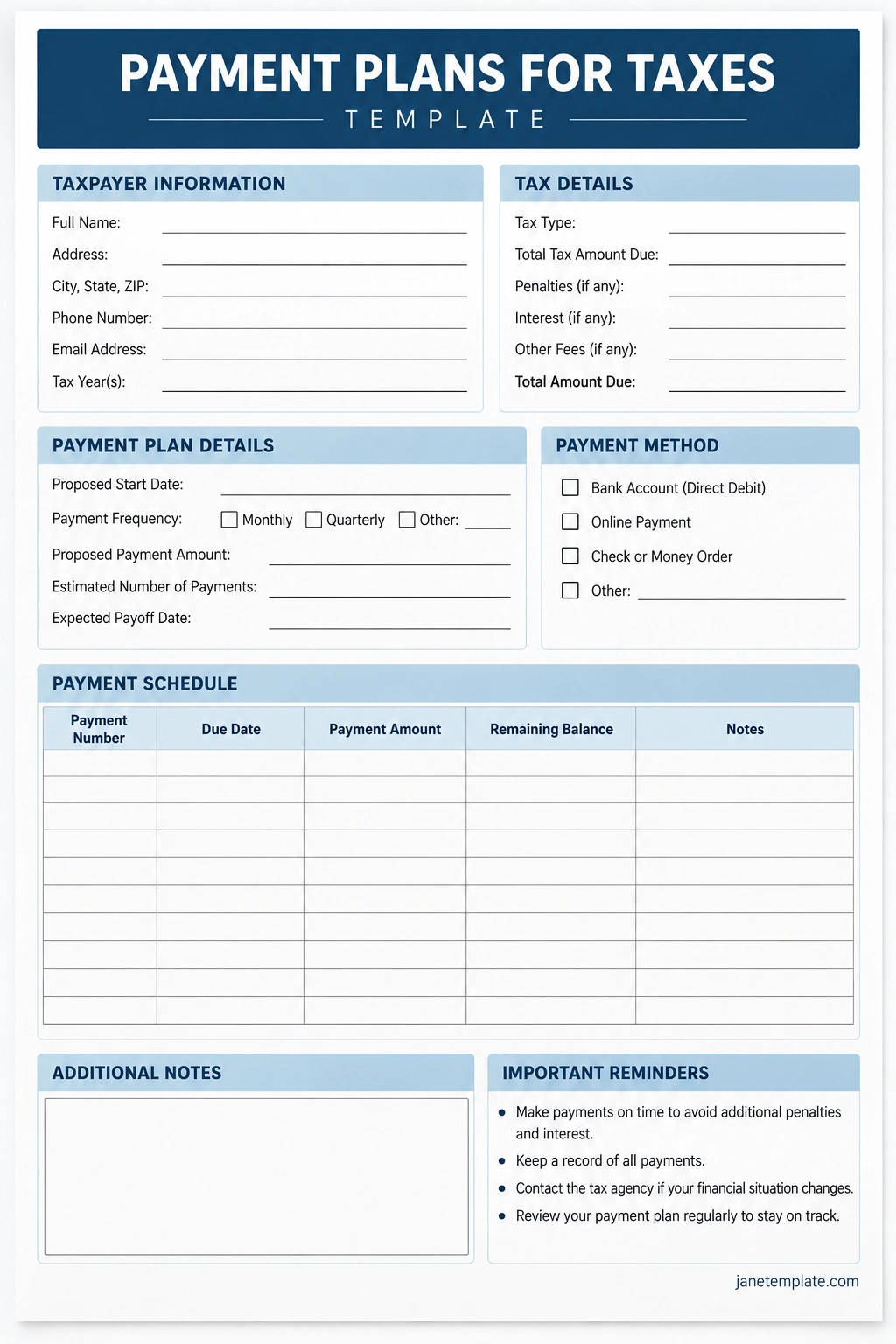
This worksheet includes sections for taxpayer information, tax details, payment arrangements, and payment methods. Its payment schedule also provides space to record individual installments and track the remaining balance.
You can use this worksheet as a personal recordkeeping tool when preparing to apply for a payment arrangement or monitoring an existing agreement. However, it is not an official IRS application form and does not establish or approve an installment agreement.
What Information Should a Tax Payment Plan Include?
Whether you are creating a personal payment schedule or organizing an existing installment agreement, recording the right information can make the process easier.
Taxpayer Information
Include basic identifying and contact details, such as:
- Full name or business name.
- Mailing address.
- City, state, and ZIP code.
- Phone number.
- Email address.
- Relevant tax year or tax periods.
Tax Details
Record the financial details associated with the outstanding tax obligation, including the tax type, original balance, applicable penalties, interest, and total amount due.
Payment Plan Details
Document the proposed or approved start date, payment frequency, installment amount, estimated number of payments, and expected payoff date.
Payment Schedule
A payment schedule is one of the most useful parts of a tax payment worksheet. It provides a chronological record of installments and helps taxpayers monitor their progress.
Consider including these columns:
- Payment number.
- Payment due date.
- Payment amount.
- Remaining balance.
- Payment notes or confirmation details.
Update the schedule whenever a payment is made. Remember that interest and penalties may affect the actual remaining balance, so compare your personal records with your official tax account.
Tips for Managing Your Tax Payment Plan
Once your payment arrangement is approved, managing it consistently is essential. The following practices can help you stay organized and avoid unnecessary problems.
1. Choose an Affordable Monthly Payment
Consider your regular income, living expenses, and other financial obligations before agreeing to a payment amount. A realistic installment is easier to maintain over time.
2. Consider Automatic Payments
Automatic bank withdrawals can help prevent missed payment dates. If you choose an automatic payment arrangement, make sure sufficient funds are available in your account on the scheduled date.
3. Keep Records of Every Payment
Save payment confirmations, bank records, IRS notices, and copies of your installment agreement. These documents can help you verify transactions and resolve potential account discrepancies.
4. Continue Filing Your Tax Returns
An existing payment arrangement does not remove your responsibility to file future tax returns on time. You must also pay new tax obligations as required and follow the terms of your agreement.
5. Review Your Tax Balance Regularly
Check your IRS Online Account periodically to monitor payments and outstanding balances. This helps you identify discrepancies and understand how much remains to be paid.
6. Contact the IRS if Your Financial Situation Changes
If you cannot afford your scheduled installment, contact the IRS as soon as possible. Depending on your circumstances, you may be able to request a change to your payment amount or due date.
Common Mistakes to Avoid With Tax Payment Plans
Managing tax debt requires attention to deadlines and payment conditions. Avoid these common mistakes when setting up or maintaining a tax installment agreement:
- Ignoring tax notices: Always review official correspondence and respond within the required timeframe.
- Choosing an unrealistic payment amount: Avoid agreeing to installments that exceed your actual financial capacity.
- Missing payment deadlines: Late or missed payments can put an installment agreement at risk.
- Ignoring interest and penalties: Remember that these charges generally continue until the outstanding balance is fully paid.
- Failing to file future returns: Keep all required tax filings current while maintaining your agreement.
- Not updating payment information: Notify the IRS or update your account if your banking details or contact information change.
- Assuming a worksheet is official approval: A personal payment schedule is only a planning document, not an IRS-approved payment arrangement.
Frequently Asked Questions About Payment Plans for Taxes
Can I set up a payment plan if I cannot pay my taxes in full?
Yes. Eligible taxpayers may request an IRS payment plan if they cannot pay their federal tax balance in full. Depending on their circumstances, they may qualify for a short-term payment plan or a long-term installment agreement.
How long can I take to pay my tax debt?
Eligible individuals may qualify for a short-term payment plan of up to 180 days or a long-term installment agreement. Some long-term arrangements may allow extended repayment periods, depending on the taxpayer’s circumstances and applicable IRS requirements.
Does the IRS charge a fee for a payment plan?
Short-term payment plans generally have no IRS setup fee. Long-term installment agreements may have setup fees that vary depending on the application method and payment method. Eligible low-income taxpayers may qualify for reduced, waived, or reimbursed fees under applicable conditions.
Does interest continue to accumulate during an IRS payment plan?
Yes. Interest and applicable late payment penalties generally continue to accrue on unpaid tax balances until they are paid in full. Setting up an installment agreement does not automatically stop these charges.
Can I pay more than my required monthly installment?
Generally, taxpayers can make additional payments toward their outstanding tax balance. Paying more when financially possible may help reduce the balance sooner and limit additional interest and penalties. Check your agreement and official IRS payment instructions before submitting extra payments.
What happens if I miss an IRS installment payment?
Missing a scheduled payment can put your installment agreement at risk of default or termination. Contact the IRS promptly if you cannot make a payment or have already missed a deadline. A reinstatement fee may apply in certain situations.
Can I change my monthly tax payment amount?
In many cases, taxpayers can request changes to their existing payment arrangements. Eligible individuals may be able to revise their monthly payment amount or due date through their IRS Online Account. Other situations may require contacting the IRS directly.
Can businesses use payment plans for taxes?
Yes. Businesses may request tax payment arrangements from the IRS, although eligibility and application procedures can differ from individual taxpayer arrangements. Business owners should contact the IRS using the number on their notice or the business tax assistance line.
Is a tax payment plan worksheet an official IRS form?
No. A tax payment plan worksheet is a personal organizational tool used to record tax information and track installments. The official IRS application for an individual installment agreement is Form 9465, when applicable.
Do state taxes qualify for the same payment plans?
Not necessarily. State tax agencies have their own payment arrangements, eligibility requirements, fees, and application procedures. Contact the relevant state tax authority to learn about available options for outstanding state tax balances.
Conclusion
Payment plans for taxes can provide a practical way to manage outstanding tax obligations when paying the full balance immediately is not financially possible. By choosing an appropriate arrangement, taxpayers can organize their installments and work toward resolving their tax debt over time.
Before applying, review your outstanding balance, assess your monthly budget, and understand the applicable interest, penalties, and setup fees. Once an agreement is approved, follow the payment schedule, keep accurate records, and stay current with future tax filing requirements.
Using a printable tax payment plan worksheet can also make it easier to organize important information and monitor your repayment progress. With proper planning and consistent payments, you can manage your tax obligations more effectively.
Download: Payment Plans for Taxes
