Planning a funeral can be emotionally and financially challenging, especially when families need to make important decisions within a short period. The cost of funeral or cremation services can add up quickly, making it difficult to pay the entire amount at once. A funeral home payment plan can help families organize these expenses and manage payments over an agreed period.
Whether you are arranging a traditional funeral, cremation, or memorial service, understanding your payment options can make the process easier. A clear payment arrangement helps you review the total cost, understand installment requirements, and keep track of upcoming due dates.
In this guide, you will learn how funeral home payment plans work, what expenses to include, which questions to ask before signing an agreement, and how to use a funeral payment plan worksheet to organize your finances.
What Is a Funeral Home Payment Plan?
A funeral home payment plan is a financial arrangement that allows families to pay for funeral or cremation services over time instead of paying the entire balance upfront. Depending on the funeral home’s policies, payments may be divided into scheduled installments or arranged through an approved financing provider.
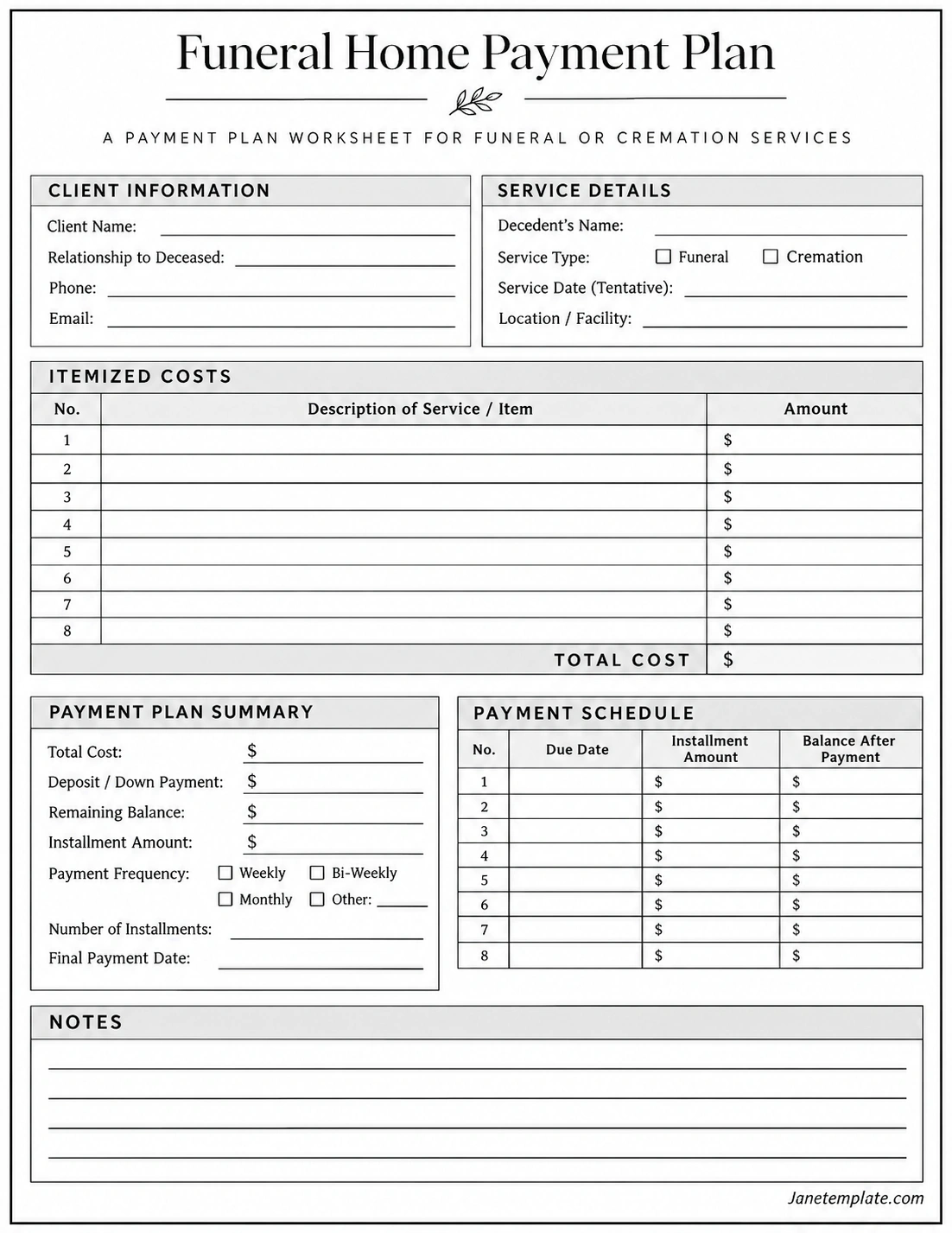
Each provider may have different payment requirements. Some funeral homes offer in-house payment arrangements, while others work with third-party financing companies. Certain providers may also require a deposit before services are confirmed.
A typical funeral payment plan may include:
- Total funeral cost: The estimated or agreed price of the selected services and products.
- Down payment: The initial amount paid when establishing the arrangement.
- Remaining balance: The amount left after subtracting the initial payment.
- Installment amount: The amount due for each scheduled payment.
- Payment frequency: Weekly, biweekly, or monthly payment intervals, depending on the agreement.
- Final payment date: The expected date when the outstanding balance will be paid.
Having these details in writing helps families understand their financial responsibilities and avoid confusion throughout the payment period.
How Does a Funeral Home Payment Plan Work?
Although payment arrangements vary between providers, most installment plans follow a straightforward process. Families first discuss their service requirements, receive a cost estimate, and review the available payment options.
1. Request an Itemized Funeral Cost Estimate
Start by asking the funeral home for a written estimate of the services and products you are considering. An itemized breakdown makes it easier to understand where the money will go.
Depending on your arrangements, the estimate may include:
- Basic professional services and staff fees.
- Funeral home facilities and service coordination.
- Transportation and transfer of the deceased.
- Embalming and preparation services, if selected.
- Casket, urn, or other merchandise.
- Funeral ceremony or memorial service expenses.
- Cemetery or crematory-related charges.
- Flowers, printed materials, and additional arrangements.
Not every family needs all these services. Review each item carefully and ask whether it is optional or required for the arrangement you have chosen.
2. Discuss Available Payment Options
Once you understand the estimated cost, ask the funeral home which payment methods are available. Some providers may offer installment arrangements directly, while others may refer families to an external financing company.
Common options include:
- In-house payment arrangements: Payments are made directly to the funeral home under its agreed terms.
- Third-party financing: An outside financing provider may offer credit or installment payments, subject to approval.
- Credit card payments: Some families use an existing credit card, although interest and fees may apply.
- Insurance assignments: Eligible life insurance benefits may be assigned to help cover certain funeral expenses, subject to the policy and provider requirements.
- Prepaid funeral arrangements: Funds are arranged in advance for future funeral services. These are different from payment plans for immediate arrangements.
Ask about eligibility requirements, interest charges, administrative fees, and payment deadlines before choosing an option.
3. Calculate the Down Payment and Installments
After selecting a payment option, calculate how much needs to be paid initially and how the remaining balance will be divided.
For example, assume the estimated funeral cost is $6,000 and the family makes a $1,000 down payment. The remaining balance is $5,000. If the provider agrees to six equal monthly installments without additional charges, each payment would be approximately $833.33.
This is only an illustration. Actual installment amounts may differ if the agreement includes interest, financing fees, or other charges.
4. Review and Sign the Payment Agreement
Before signing, carefully review the written agreement. Make sure the total cost, down payment, installment amount, payment dates, and applicable fees are clearly stated.
Keep a copy of the agreement and all payment receipts. These records can help resolve billing questions and confirm how much has already been paid.
What Should Be Included in a Funeral Payment Plan Worksheet?
A funeral home payment plan worksheet is a simple document that helps families organize funeral expenses and monitor installment payments. Instead of keeping financial details in separate notes or messages, you can record everything in one place.
A useful worksheet should include the following sections.
1. Family and Funeral Service Information
Begin with basic information about the person arranging the funeral and the selected services. Include the funeral home’s name, contact details, service type, and estimated service date.
This information makes the worksheet easier to identify and reference when communicating with the provider.
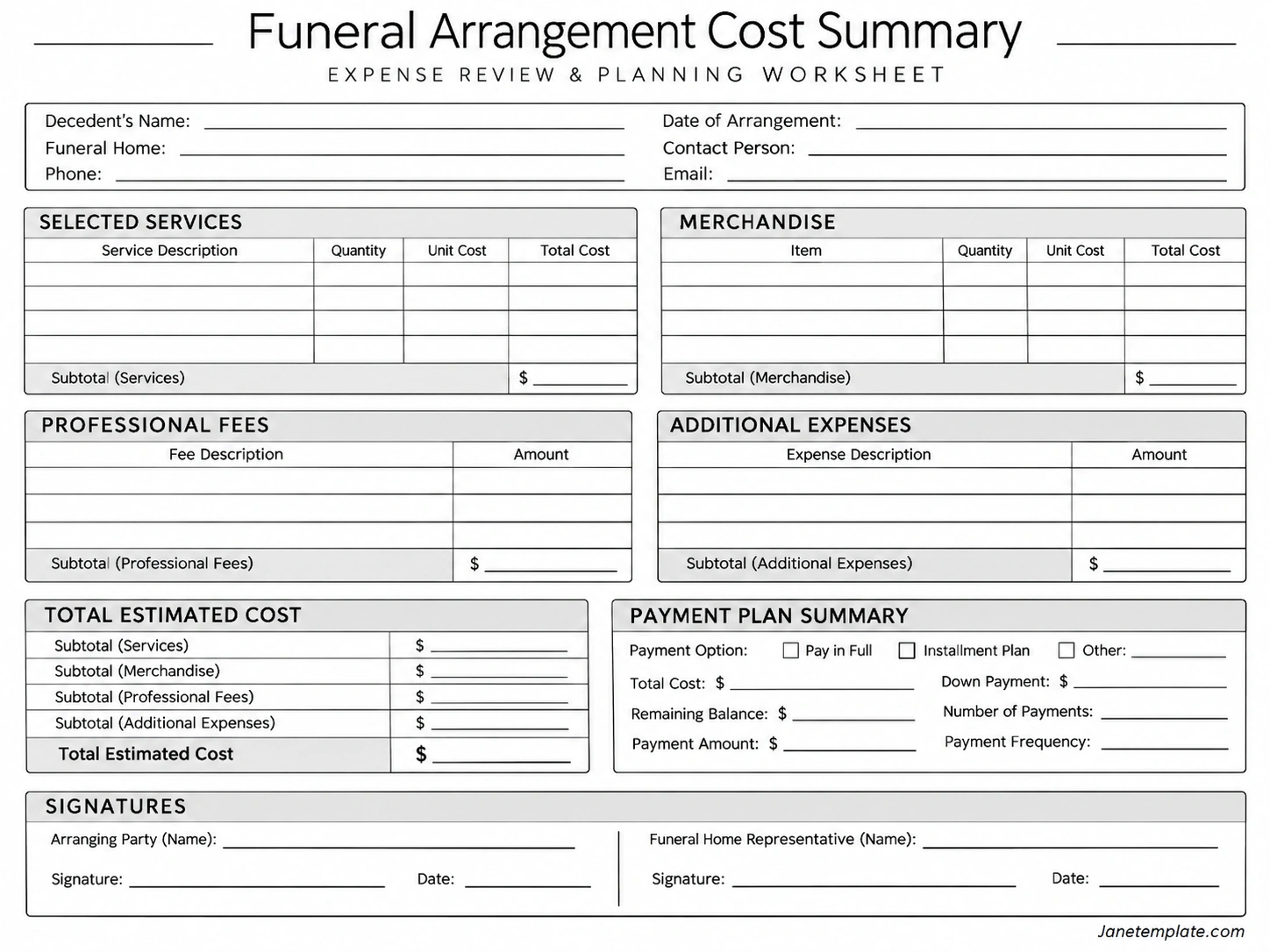
2. Itemized Cost Breakdown
Record each service, product, and additional expense separately. Avoid entering only one combined amount because an itemized list makes it easier to review the total and identify potential adjustments.
Useful columns include:
- Service or product description.
- Quantity, when applicable.
- Unit price.
- Total cost.
- Additional notes.
Once all expenses are listed, calculate the estimated total funeral cost.
3. Payment Plan Summary
This section provides a quick overview of the financial arrangement. Record the total cost, down payment, remaining balance, installment amount, payment frequency, and number of scheduled payments.
It is also helpful to include the financing provider’s name and any applicable interest or administrative charges.
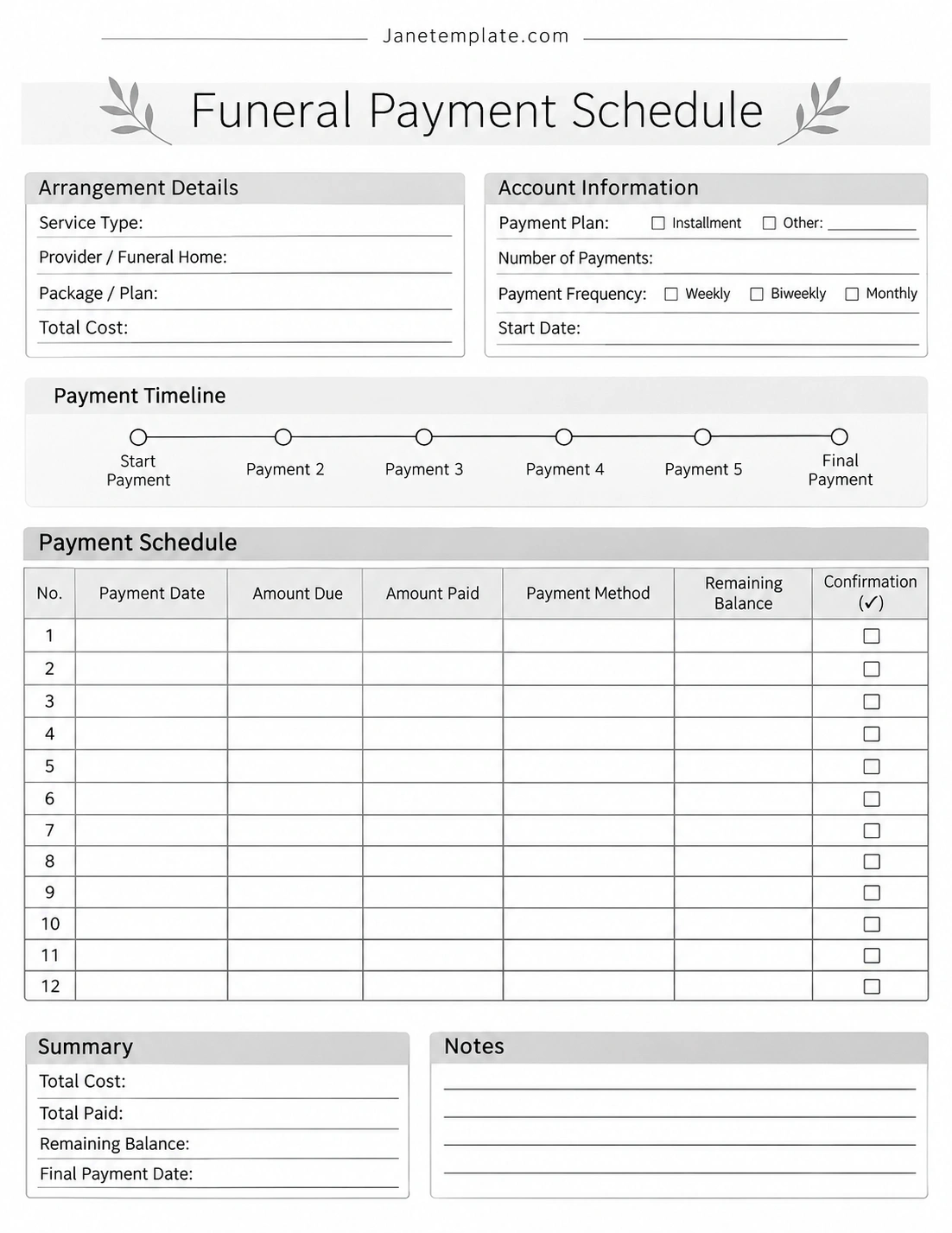
4. Payment Schedule and Tracking
A payment schedule allows families to monitor every installment. Record the due date, amount due, amount paid, payment method, and remaining balance after each transaction.
Use a confirmation checkbox or payment status column to identify completed installments. Update the worksheet whenever a payment is made.
A written payment schedule can also help families identify upcoming deadlines and avoid accidentally missing a scheduled installment.
How to Use a Funeral Home Payment Plan Template
A printable funeral home payment plan template can simplify the process of organizing costs and payment responsibilities. You can use a blank worksheet during discussions with the funeral home or after receiving a written estimate.
Follow these practical steps to complete your worksheet.
- Step 1: Enter the family contact information and funeral home details.
- Step 2: List the selected funeral or cremation services and their estimated prices.
- Step 3: Calculate the total estimated cost.
- Step 4: Enter the agreed down payment and calculate the remaining balance.
- Step 5: Record the installment amount and payment frequency.
- Step 6: Add each payment due date to the schedule.
- Step 7: Update the amount paid and remaining balance after every transaction.
Remember that a printable worksheet is an organizational tool, not a substitute for the official funeral service contract or financing agreement. Always use the provider’s written terms as the authoritative record of your payment obligations.
Tips for Choosing an Affordable Funeral Payment Plan
Choosing a payment arrangement requires more than comparing the monthly installment amount. A plan that appears affordable initially may become expensive if it includes additional fees or high interest charges.
Consider these tips before making a decision.
Compare More Than One Funeral Home
Request itemized estimates from multiple providers when practical. Compare similar services and products rather than looking only at the final price. This helps you understand which expenses are included and where adjustments may be possible.
Understand Interest Rates and Additional Fees
Ask whether the payment arrangement includes interest, processing charges, late fees, or other financing costs. If a third-party lender is involved, review the credit terms separately from the funeral home’s service agreement.
Choose a Realistic Payment Schedule
Select an installment amount that fits your household budget. Consider existing bills, essential expenses, and other financial responsibilities before agreeing to a payment schedule.
A longer payment period may reduce individual installments, but it could increase the total amount paid when interest or fees apply.
Ask About Payment Deadlines and Cancellation Policies
Confirm when the first payment is due, whether the balance must be paid before the service takes place, and what happens if a payment is late. Also ask about refunds, cancellations, and changes to the selected arrangements.
Keep All Financial Records
Save the original estimate, signed agreement, invoices, receipts, and updated payment schedule. Keeping these documents together makes it easier to verify transactions and resolve disagreements.
Funeral Home Payment Plan vs. Prepaid Funeral Plan
Although these terms sound similar, a funeral home payment plan and a prepaid funeral plan serve different purposes.
A funeral home payment plan generally helps families manage the cost of arrangements being made now. A prepaid funeral plan is designed to fund or arrange funeral services before they are needed in the future.
Here are the main differences:
- Funeral home payment plan: Payments are made toward current funeral or cremation expenses under an agreed arrangement.
- Prepaid funeral plan: Money is set aside or paid in advance for future funeral services, subject to the contract and applicable rules.
- Payment timing: An immediate payment arrangement is associated with current services, while prepaid arrangements are established before the need for those services.
- Contract terms: Both arrangements can have different rules regarding refunds, transfers, cancellation, and payment obligations.
Before purchasing a prepaid plan, ask how the funds are held, whether prices are guaranteed, what happens if you move, and what protections apply if the provider closes.
Frequently Asked Questions About Funeral Home Payment Plans
Can you make monthly payments to a funeral home?
Yes, some funeral homes offer monthly payment arrangements or work with third-party financing companies. However, availability depends on the provider’s policies and the family’s eligibility. Ask about installment amounts, interest, fees, and payment deadlines before agreeing to a plan.
Do all funeral homes offer payment plans?
No. Not every funeral home provides in-house financing or installment payments. Some require payment before services are performed, while others accept approved third-party financing. Contact the provider directly to understand its available options.
How much is a typical funeral home down payment?
There is no universal down payment amount. The required deposit depends on the funeral home’s policies, selected services, and financing arrangement. Request a written estimate that clearly identifies the initial payment and remaining balance.
Can you finance funeral expenses with bad credit?
Possibly, but approval depends on the financing provider’s requirements. Some funeral homes may offer alternative arrangements, while third-party lenders may review credit history, income, and other eligibility factors. Always compare the total repayment cost before accepting financing.
What happens if you cannot make a funeral payment on time?
The consequences depend on the signed agreement. Possible outcomes include late fees, additional interest, changes to the payment arrangement, or collection activity. Contact the funeral home or financing provider as soon as possible if you anticipate missing a payment.
Can life insurance pay for funeral expenses?
Life insurance benefits may help cover funeral costs, depending on the policy, beneficiary arrangements, and processing requirements. Some funeral homes may accept an insurance assignment, but this is not guaranteed. Confirm the process with both the insurer and funeral home.
What is the difference between a funeral payment schedule and a funeral payment plan?
A funeral payment plan describes the overall financial agreement, including the balance, installment amount, and repayment terms. A funeral payment schedule lists individual payment dates and amounts. Both documents can be used together to organize funeral expenses.
Can I use a printable funeral home payment plan worksheet?
Yes. A printable worksheet can help you organize itemized costs, calculate the remaining balance, record installment dates, and track completed payments. However, it should be used alongside the official contract and receipts rather than as a replacement.
Final Thoughts
Managing funeral expenses can be difficult during an already emotional time. A well-organized funeral home payment plan can make financial responsibilities easier to understand by dividing costs into clear, manageable steps.
Before choosing an arrangement, request an itemized estimate, compare available payment options, review all financing terms, and confirm the repayment schedule in writing. These steps can help families make informed decisions without overlooking important financial details.
Using a printable funeral home payment plan worksheet is another practical way to stay organized. By recording expenses, down payments, installment dates, and remaining balances in one place, you can maintain a clearer picture of the financial arrangement from beginning to end.
