Dental implants can be a valuable long-term solution for replacing missing teeth, but the cost of treatment can feel overwhelming. Between consultations, implant placement, abutments, crowns, and follow-up appointments, the total expense may involve several different payments. Fortunately, a payment plan for teeth implants can help make the process more organized and financially manageable.
Whether you are planning to pay out of pocket, use dental insurance, or explore monthly financing, having a clear budget can make a significant difference. A dental implant payment plan worksheet helps you break down treatment costs, estimate your financial responsibility, and schedule payments before starting the procedure.
In this guide, you will learn how dental implant payment plans work, what expenses to include, which financing options to consider, and how to create a practical budget for your treatment.
What Is a Payment Plan for Teeth Implants?
A payment plan for teeth implants is a financial arrangement that divides the total cost of dental implant treatment into smaller, scheduled payments. Instead of paying the entire amount at once, patients may pay according to treatment stages or follow an agreed monthly installment schedule.
Depending on the dental office and financing provider, payment arrangements may include:
- In-office payment plans: Payments arranged directly with the dental practice.
- Monthly installments: Regular payments spread over an agreed period.
- Third-party financing: Loans or healthcare financing products offered by external providers.
- Insurance contributions: Eligible benefits that may reduce certain treatment expenses.
- Personal savings: Money set aside specifically for dental treatment.
Not every dental office offers the same arrangements. Some require payment before each treatment stage, while others may allow eligible patients to use financing. Always request written terms before agreeing to a payment arrangement.
What Costs Should You Include in a Dental Implant Budget?
Before choosing a payment schedule, it is important to understand the different expenses involved. Dental implant treatment is not always a single procedure with one fixed price. The total cost depends on your oral health, the number of implants needed, the materials used, and the complexity of treatment.
1. Initial Consultation and Diagnostic Imaging
The first stage usually involves a dental examination and treatment planning. Your dentist may recommend X-rays, photographs, or a cone beam CT scan to evaluate your jawbone and determine whether implant placement is appropriate.
Include consultation fees and diagnostic imaging expenses in your initial budget.
2. Tooth Extraction and Additional Procedures
Some patients need a damaged tooth removed before receiving an implant. Others may require additional procedures, such as bone grafting or a sinus lift, depending on their individual condition.
These services can increase the overall treatment cost, so ask your dentist whether they are included in the original estimate or billed separately.
3. Dental Implant Placement
This is the surgical stage in which the implant fixture is placed into the jawbone. The fee may include the implant component, surgical procedure, and certain related services. However, inclusions vary between dental practices.
4. Abutment and Final Crown
The abutment connects the implant fixture to the final restoration. A dental crown is then attached to restore the appearance and function of the missing tooth.
Ask whether the abutment and crown are included in the quoted implant price. Some estimates list these components separately.
5. Follow-Up Appointments
Follow-up visits help your dentist monitor healing and evaluate the implant restoration. Depending on your treatment plan, additional appointments or adjustments may involve separate fees.
How to Create a Payment Plan for Teeth Implants
Creating a realistic budget does not have to be complicated. The key is to organize every expected expense and compare it with the money available for treatment.
Step 1: Request an Itemized Treatment Estimate
Ask your dental office for a written estimate that lists every expected service. Avoid relying only on a general package price because certain procedures may not be included.
Your estimate should ideally identify:
- Consultation and diagnostic imaging.
- Tooth extraction, if necessary.
- Implant fixture and surgical placement.
- Bone grafting or additional procedures, if required.
- Abutment and final crown.
- Follow-up visits and other related services.
Step 2: Calculate Your Total Treatment Cost
Add the estimated fees for all planned procedures. This gives you a starting figure for your dental implant budget.
For example, your worksheet might include the following categories:
- Initial consultation: $150
- Diagnostic imaging: $200
- Implant placement: $1,800
- Abutment: $500
- Final crown: $1,200
Illustrative total: $3,850. These figures are examples for budgeting purposes only, not typical or guaranteed treatment prices. Actual fees vary by location, provider, and clinical needs.
Step 3: Identify Your Available Contributions
Next, determine how much of the estimated cost can be covered through available financial resources.
Possible contributions include:
- Dental insurance benefits, if the treatment is covered.
- Personal savings.
- Health savings or flexible spending accounts, where eligible.
- Employer-sponsored dental benefits.
- Other approved financing arrangements.
Remember that dental insurance coverage varies significantly. Some policies may exclude implants, impose annual maximums, or require waiting periods. Confirm your actual benefits with your insurance provider before calculating your expected contribution.
Step 4: Calculate the Remaining Balance
Subtract confirmed insurance benefits and other available contributions from the total estimated treatment cost.
Remaining Balance = Total Treatment Cost – Available Contributions
Using the illustrative $3,850 estimate, assume you have $500 in confirmed insurance benefits and $850 in personal savings. Your remaining balance would be $2,500.
Step 5: Choose a Manageable Payment Schedule
Discuss available payment arrangements with your dental office. Consider how much you can comfortably pay each month without affecting essential household expenses.
Compare the monthly installment, repayment period, interest rate, administrative fees, and total amount payable before choosing a financing option.
Common Financing Options for Dental Implants
There are several ways to manage the cost of implant treatment. Each option has different requirements and financial considerations.
Dental Office Financing
Some dental practices offer payment arrangements directly to patients. These may divide treatment fees into scheduled payments linked to appointments or agreed billing dates.
Ask about deposit requirements, payment deadlines, late fees, and whether the entire balance must be settled before a particular treatment stage.
Third-Party Medical Financing
Healthcare financing companies may provide loans or credit products for eligible dental procedures. Depending on the provider, patients may have access to different repayment periods and interest rates.
Read the agreement carefully. Promotional interest offers may have specific conditions, and missing a payment deadline could increase the total cost.
Dental Insurance
Dental insurance may contribute toward certain parts of implant treatment, depending on the policy. However, coverage is not guaranteed, and some plans exclude implant-related services.
Request a pre-treatment estimate or predetermination from your insurer to understand potential benefits before beginning treatment.
Personal Savings
Saving gradually can help reduce the amount you need to borrow. Consider setting aside a fixed amount each month in a dedicated dental treatment fund.
This approach may be particularly useful if your treatment is planned several months in advance.
How a Dental Implant Payment Plan Worksheet Helps
A payment plan worksheet makes it easier to organize treatment expenses in one place. Instead of keeping separate estimates, insurance information, and payment reminders, you can use one document to track your financial progress.
A well-designed worksheet should include the following sections:
- Patient information: Name, contact details, dental clinic, and treatment date.
- Treatment breakdown: Individual procedures and estimated clinical fees.
- Insurance and savings: Expected contributions from different sources.
- Balance summary: Total cost, contributions, and remaining amount.
- Monthly payments: Due dates, installment amounts, and outstanding balances.
- Notes: Questions, payment conditions, and important reminders.
Here are three printable worksheets that can help organize different parts of your dental implant budget.
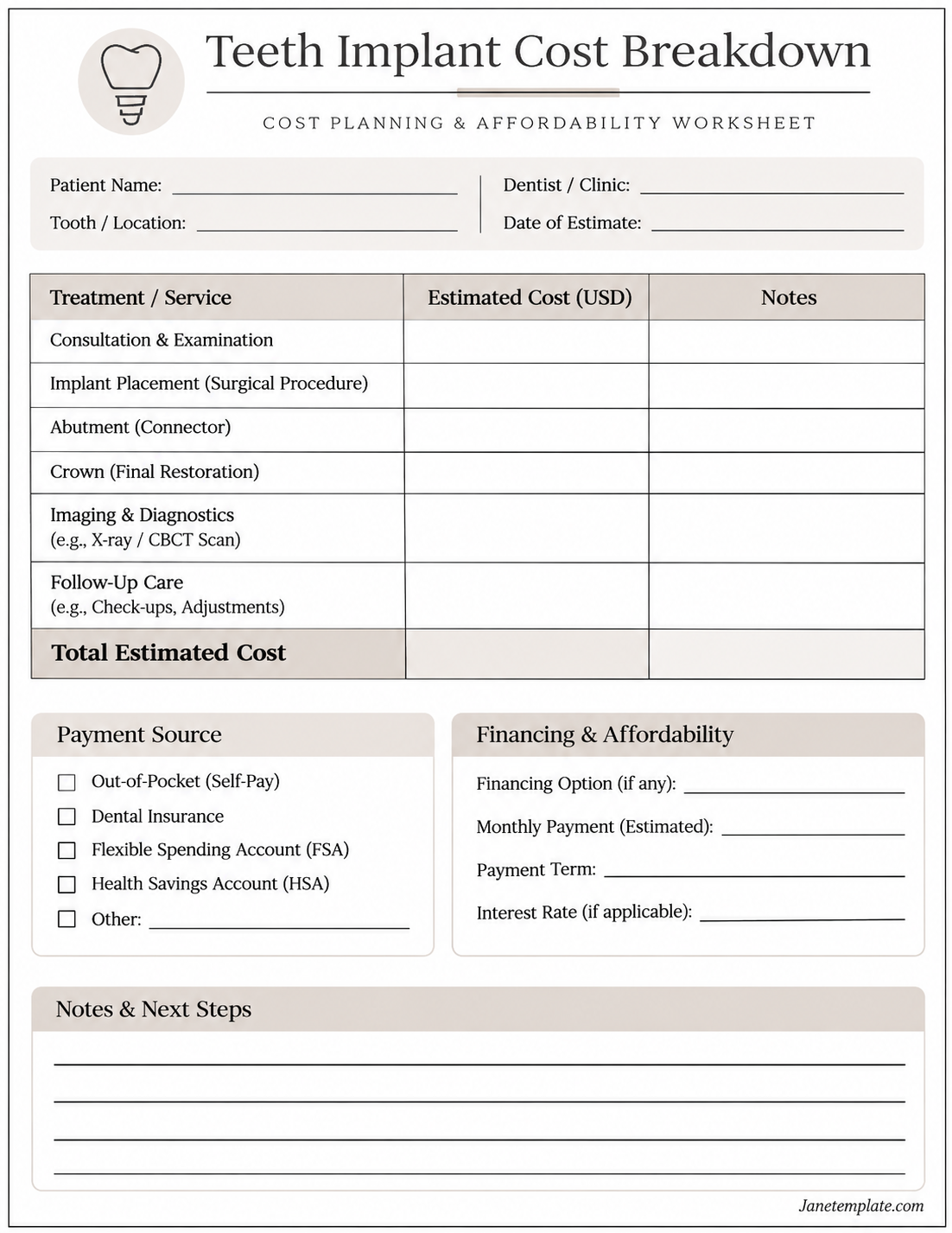
Printable 1: Teeth Implant Cost Breakdown Template
Use this worksheet to list individual dental services and estimate the total cost of treatment. It is particularly helpful when comparing written estimates from different dental providers.
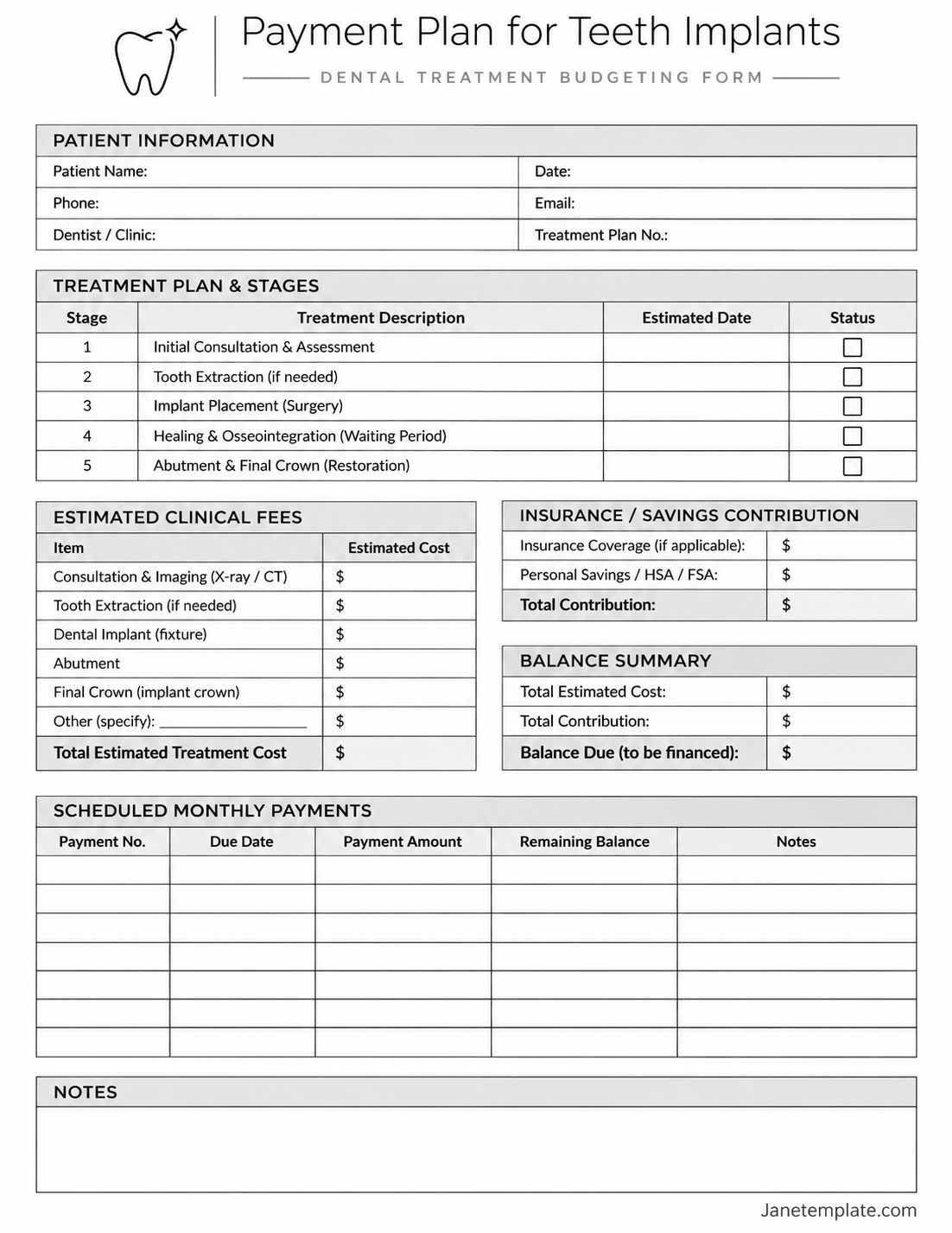
Printable 2: Payment Plan for Teeth Implants Template
This worksheet focuses on treatment stages, financial contributions, and monthly installments. Use it to compare the estimated treatment cost with your available budget and remaining balance.
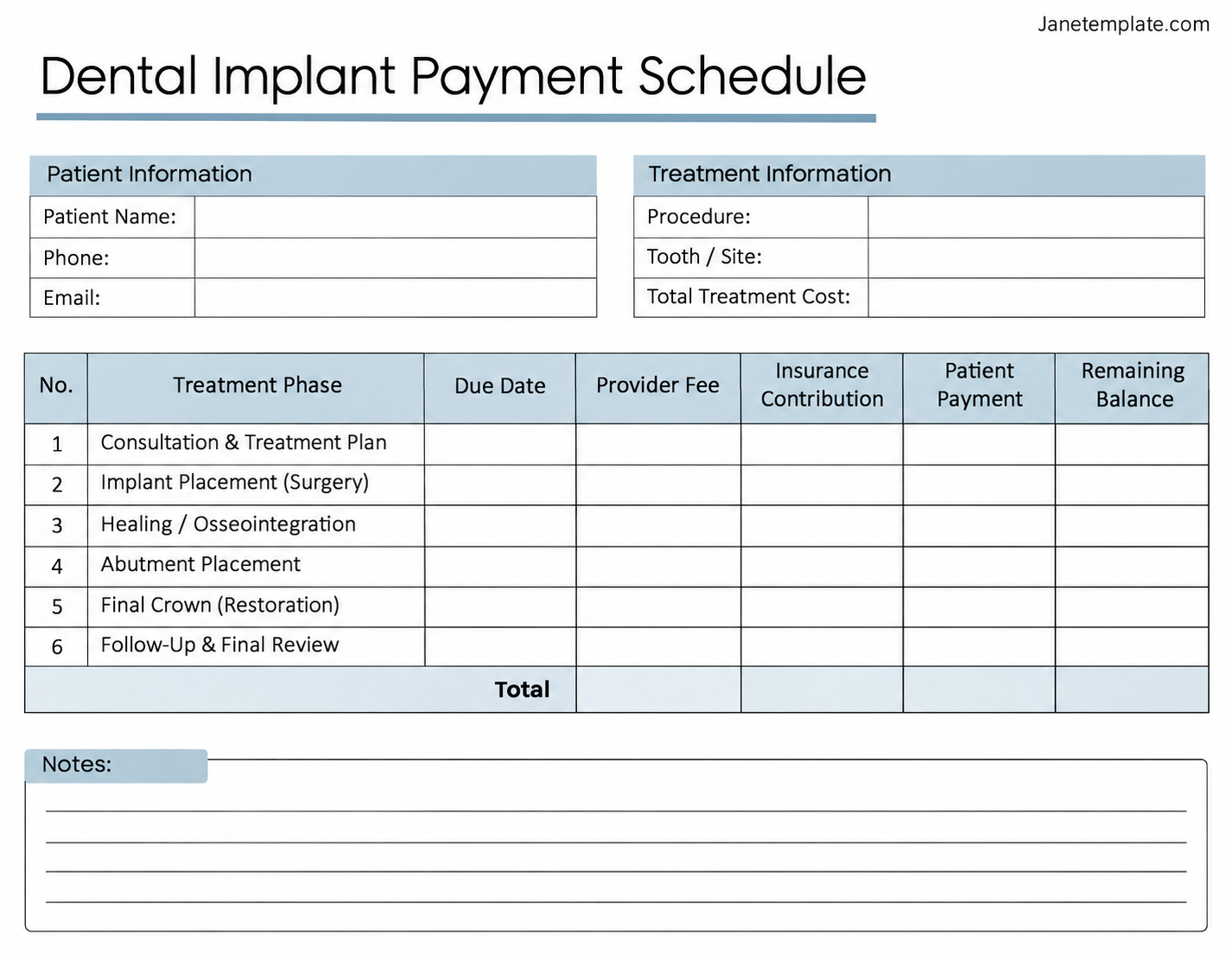
Printable 3: Dental Implant Payment Schedule Template
Use this printable to record payments according to treatment milestones. You can track due dates, provider fees, insurance contributions, patient payments, and the remaining balance for each stage.
Practical Tips for Managing Dental Implant Expenses
A good payment plan should support both your dental treatment and your overall financial stability. Keep these practical suggestions in mind:
- Compare itemized estimates: Request written quotes from qualified dental providers and compare what each price includes.
- Ask about additional fees: Confirm whether imaging, temporary restorations, medication, and follow-up visits are included.
- Verify insurance benefits: Check coverage limits, exclusions, waiting periods, and annual maximums.
- Review financing terms: Compare interest rates, fees, repayment periods, and the total repayment amount.
- Keep an emergency reserve: Avoid committing every available dollar to monthly dental payments.
- Save payment records: Keep receipts, treatment estimates, financing agreements, and insurance statements together.
- Discuss treatment priorities: Ask your dentist whether treatment can be safely staged without compromising clinical outcomes.
Most importantly, do not choose a dental provider based on price alone. Consider qualifications, experience, treatment recommendations, and the quality of follow-up care.
Frequently Asked Questions About Payment Plans for Teeth Implants
1. Can you get dental implants on a monthly payment plan?
Yes. Some dental practices and third-party financing providers offer monthly payment arrangements for eligible patients. Availability, repayment terms, and approval requirements vary. Contact your dental office to discuss the options available.
2. Do dental insurance plans cover dental implants?
Coverage depends on your individual insurance policy. Some plans may cover certain implant-related procedures, while others exclude implants entirely. Check your policy and request a pre-treatment estimate before making financial decisions.
3. What should a dental implant payment plan include?
A complete payment plan should include the total treatment estimate, individual procedure fees, insurance contributions, personal savings, remaining balance, installment amounts, due dates, and financing terms.
4. Can I pay for dental implants in stages?
Some dental offices allow patients to make payments at different treatment stages. For example, fees may be scheduled around the consultation, implant placement, and final restoration. The exact arrangement depends on the clinic’s payment policy.
5. How do I calculate my monthly dental implant payments?
For a simple interest-free installment arrangement, divide the remaining balance by the number of agreed monthly payments. For example, a $2,400 balance divided over 12 months equals $200 per month. Financing with interest or additional fees requires a more detailed calculation.
6. Are dental implant financing plans interest-free?
Not necessarily. Some providers may offer promotional interest-free arrangements to qualifying applicants, while others charge interest and fees. Always review the complete financing agreement, including promotional conditions and penalties.
7. Is it better to save money or finance dental implants?
Neither option is automatically better for everyone. Saving may reduce borrowing costs, while financing may spread expenses over time. Compare your savings, monthly budget, interest charges, and treatment timeline before deciding.
8. Can I use a payment plan worksheet for multiple dental implants?
Yes. You can use the worksheet to list multiple implant sites, separate treatment fees, and track individual payments. Ask your dental office for an itemized estimate covering all planned procedures.
Conclusion
Planning the financial side of dental implant treatment can make the process easier to understand and manage. A well-organized payment plan for teeth implants helps you identify treatment expenses, evaluate available contributions, calculate your remaining balance, and establish a realistic payment schedule.
Whether you choose personal savings, dental office financing, insurance benefits, or monthly installments, always review the complete costs and payment conditions before starting treatment.
Use a printable dental implant payment plan worksheet to keep your estimates, contributions, and payment dates organized. With a clear budget and guidance from your dental provider, you can make more informed financial decisions throughout your treatment journey.
