A notary acknowledgement form is a document used to record a notarial acknowledgment. It helps establish that a signer personally appeared before a notary public, was properly identified, and acknowledged signing a document voluntarily for its intended purpose. The acknowledgment is commonly used with legal, business, real estate, and other important documents.
Understanding how a notary acknowledgment works can help you prepare documents correctly and avoid common mistakes. While the exact wording and requirements can vary by state, the basic purpose is to document the notarial act and provide an official record associated with the signed document.
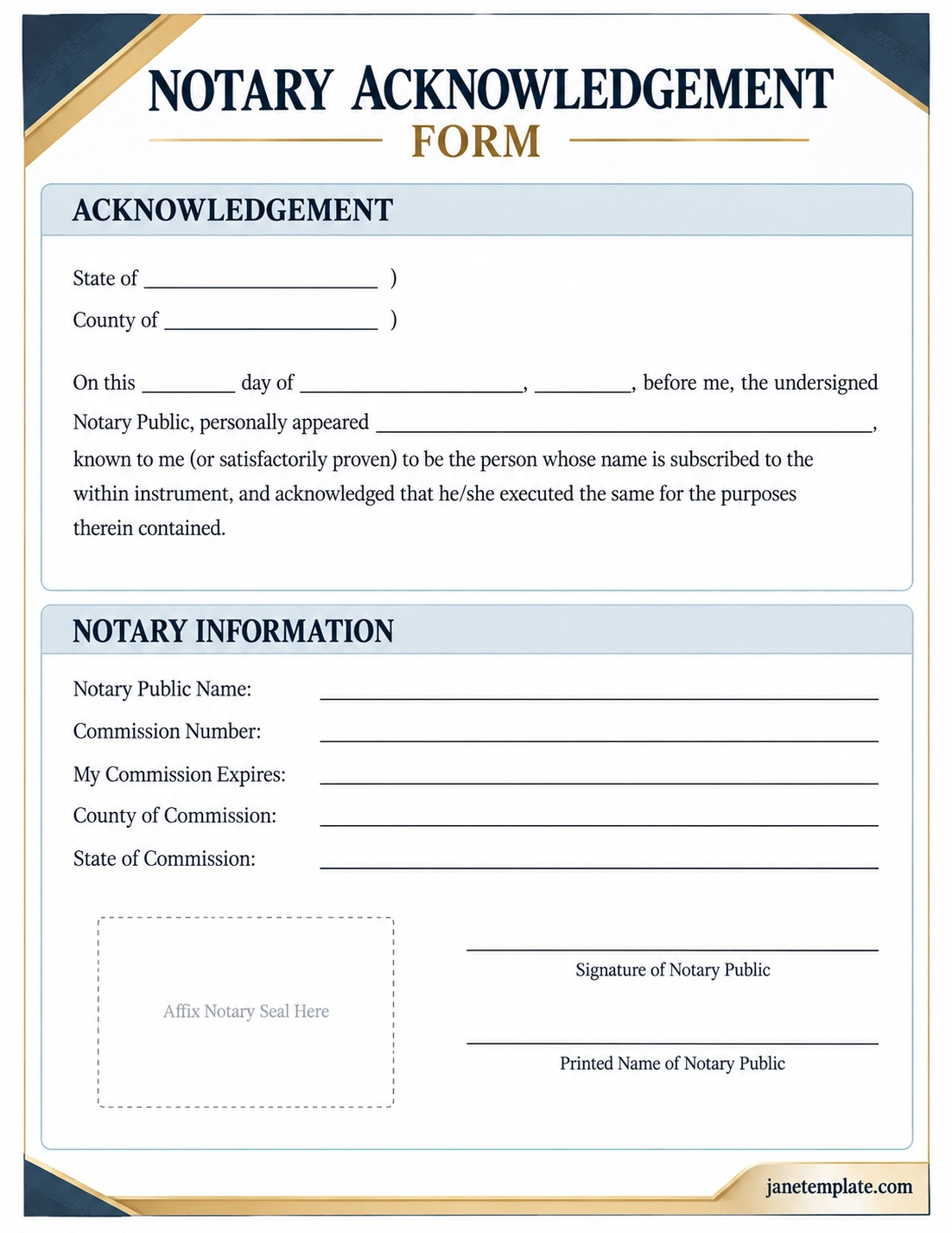
What Is a Notary Acknowledgement Form?
A notary acknowledgement form is a written certificate or form used to document an acknowledgment performed by a notary public. The signer appears before the notary and acknowledges that they signed the related document for the purposes stated in that document.
The notary generally verifies the identity of the signer according to applicable requirements and completes the acknowledgment certificate. The notary may then sign the certificate and apply the required seal or stamp.
Acknowledgment wording differs depending on the jurisdiction and type of document. For this reason, a generic notary acknowledgement form should be treated as a starting point rather than a substitute for a state-required certificate.
What Does a Notary Acknowledgment Verify?
A notarial acknowledgment is primarily concerned with the identity and acknowledgment of the signer. It is important to understand what the notary is and is not certifying.
In general, an acknowledgment indicates that the signer personally appeared before the notary and acknowledged executing the document. The notary’s role does not normally involve determining whether the statements contained in the underlying document are true or whether the agreement is legally appropriate.
- Identity: The notary follows applicable procedures to identify the signer.
- Personal appearance: The signer appears before the notary as required by applicable law.
- Acknowledgment: The signer confirms that they executed or signed the document.
- Voluntary execution: The acknowledgment generally indicates that the signer is acknowledging the signature willingly.
- Notarial act: The notary completes the certificate according to applicable requirements.
What Is Included in a Notary Acknowledgement Form?
A typical notary acknowledgement form contains several pieces of information that identify the notarial act. The exact layout and wording can vary by jurisdiction.
State and County Information
The certificate commonly identifies the state and county or other applicable jurisdiction where the acknowledgment takes place. These fields establish the location associated with the notarial act.
Date of Acknowledgment
The date of the acknowledgment is recorded in the certificate. This date should accurately reflect when the signer appeared before the notary and the notarial act was performed.
Signer Information
The acknowledgment certificate identifies the person who appeared before the notary. The name should be recorded accurately and consistently with the applicable document and identification requirements.
Acknowledgment Statement
The certificate contains formal wording stating that the signer appeared before the notary and acknowledged executing the document. The wording can differ significantly between states.
Notary Information
The form may include the notary public’s name, commission information, commission expiration date, jurisdiction, signature, and other information required by local law.
Notary Seal or Stamp
Many notarial certificates include a designated area for the notary’s official seal or stamp. The requirements for a seal or stamp depend on the applicable jurisdiction.
How Does a Notary Acknowledgment Work?
The process generally follows a series of steps, although specific requirements can vary by jurisdiction and document type.
1. Prepare the Document
Before meeting with the notary, make sure the document is complete and ready for signing. Do not sign it prematurely if the applicable notarial procedure requires the signature to be acknowledged in the notary’s presence.
2. Appear Before the Notary
The signer appears before the notary according to the requirements applicable to the notarial act. The notary determines whether the signer can be properly identified and whether the acknowledgment can proceed.
3. Confirm the Acknowledgment
The signer acknowledges that they signed or executed the document. The notary records the acknowledgment using the appropriate certificate wording.
4. Complete the Certificate
The notary completes the applicable fields, including the date, jurisdiction, signer information, and other required details.
5. Sign and Seal the Certificate
The notary signs the certificate and applies the required seal or stamp when applicable. The completed certificate becomes part of the documentation associated with the notarial act.
When Is a Notary Acknowledgement Form Used?
Notarial acknowledgments can be associated with many types of documents. The requirement depends on the document, transaction, receiving organization, and applicable law.
Common examples may include:
- Real estate documents
- Deeds and property-related instruments
- Business documents
- Contracts and agreements
- Power of attorney documents
- Affidavits and related legal documents
- Financial or commercial documents that require notarization
- Documents intended for use in another jurisdiction
Not every document requires an acknowledgment. Some documents may require a different type of notarial act, such as a jurat. Always confirm which notarial certificate is appropriate before completing the document.
Notary Acknowledgment vs. Jurat
A common source of confusion is the difference between an acknowledgment and a jurat. Although both involve a notary public, they serve different purposes.
With an acknowledgment, the signer generally acknowledges that they executed the document. The emphasis is on the signer acknowledging the signature or execution.
A jurat generally involves the signer making a sworn statement or affirmation regarding the truthfulness of the contents of the document. The signer typically signs in the presence of the notary as part of that notarial act.
Because requirements and wording vary by jurisdiction, the appropriate certificate should be selected based on the specific document and applicable law.
How to Use a Notary Acknowledgement Form Template
A notary acknowledgement form template can provide a convenient structure for organizing the information associated with an acknowledgment. However, a template should be reviewed carefully before use.
Follow these practical steps:
- Confirm the state or jurisdiction where the acknowledgment will occur.
- Check whether the receiving organization has a preferred certificate.
- Use the legally appropriate acknowledgment wording.
- Complete names and dates accurately.
- Leave any notary-only sections for the notary to complete when appropriate.
- Confirm the required seal or stamp requirements.
- Review the completed certificate for missing or incorrect information.
A printable template can be particularly useful for preparing paperwork, organizing documents, or understanding the typical structure of an acknowledgment certificate.
Tips for Completing a Notary Acknowledgement Form
Check the Jurisdiction
Notarial requirements are not necessarily identical across the United States. Confirm the rules applicable to the jurisdiction where the notarization takes place.
Use Accurate Names
Names should be entered carefully. Differences between the underlying document, identification, and acknowledgment certificate can create unnecessary questions or delays.
Do Not Guess Missing Information
If a field requires information that you do not know, do not invent an answer. Ask the appropriate person or notary how the field should be completed.
Do Not Complete Notary-Only Sections
Some portions of a notarial certificate are intended for the notary public. Leave those sections for the notary when required by the applicable procedure.
Review Before Signing
Check the document and certificate for obvious errors before the notarial act is completed. Correcting mistakes before completion can help prevent delays or the need for a new certificate.
Common Mistakes to Avoid
Several simple errors can make a notarial certificate incomplete or unsuitable for its intended purpose.
- Using acknowledgment wording that does not meet applicable requirements
- Entering an incorrect date or jurisdiction
- Misspelling the signer’s name
- Leaving required fields incomplete
- Using the wrong type of notarial certificate
- Signing at the wrong time or in the wrong manner
- Completing sections reserved for the notary
- Assuming that one acknowledgment form works for every state
When a document is important or legally significant, it is better to verify the requirements before the notarization rather than attempt to correct an invalid or incomplete certificate afterward.
Why Use a Printable Notary Acknowledgement Form?
A printable notary acknowledgement form can help organize the information required for an acknowledgment and provide a clear visual structure. It can also be useful when preparing a document package that requires a separate acknowledgment certificate.
A well-designed form should provide enough space for the required information while keeping the certificate easy to read. Clear headings, organized fields, and a designated area for the notary’s signature and seal can make the document easier to review.
However, appearance should never take priority over legal requirements. If a government agency, court, title company, attorney, or other organization provides a required certificate, use the version they specify.
Frequently Asked Questions About Notary Acknowledgement Forms
What is a notary acknowledgement form?
A notary acknowledgement form is a certificate used to document that a signer appeared before a notary and acknowledged executing a document. It typically includes jurisdiction, date, signer, notary, signature, and seal information.
Does a notary acknowledgement prove that a document is legally valid?
No. A notarial acknowledgment generally confirms the notarial act and the signer’s acknowledgment. It does not normally determine whether the underlying document is legally valid, accurate, or enforceable.
Does the signer have to sign in front of the notary?
The requirements depend on the type of notarial act and applicable jurisdiction. For an acknowledgment, the signer generally appears before the notary and acknowledges the signature or execution according to the applicable rules.
Can I use the same notary acknowledgement form in every state?
Not necessarily. Notarial certificate wording and requirements can vary by state and circumstance. Always verify that the certificate meets the requirements of the jurisdiction where the notarization occurs.
Who completes a notary acknowledgement form?
The signer provides the necessary information and appears before the notary, while the notary completes the portions associated with the notarial act. Some fields may be completed before the appointment, but notary-only sections should generally be handled by the notary.
Is a notary acknowledgement the same as a jurat?
No. An acknowledgment and a jurat are different notarial acts. An acknowledgment generally concerns the signer’s acknowledgment of executing a document, while a jurat generally involves a sworn or affirmed statement.
Can I download and print a notary acknowledgement form?
A printable template can be useful for preparing documents, but the certificate should meet the requirements applicable to the specific notarization. When an official or jurisdiction-specific form is required, use that version instead.
Conclusion
A notary acknowledgement form provides a structured way to document an acknowledgment performed by a notary public. It records important information about the jurisdiction, signer, date, notary, and notarial act while providing space for the required signature and seal.
Because notarial requirements can vary by state and document type, always verify the applicable requirements before using a generic template. When properly prepared, an acknowledgment certificate can provide a clear and organized record of the notarial act and help ensure that important documents are processed correctly.
Download: Notary Acknowledgement Form
