Unexpected vehicle repairs can put pressure on your monthly budget. Whether your car needs a new transmission, brake replacement, engine repairs, or routine maintenance, the total cost can sometimes be difficult to pay all at once. A car repair payment plan can help make these expenses more manageable by spreading the cost over several scheduled payments.
A car repair payment plan is a budgeting and tracking tool or a written payment agreement that organizes vehicle repair expenses into installments. It helps vehicle owners understand the total repair cost, calculate the amount due each period, and monitor payments until the balance is paid.
Whether you are working with an auto repair shop or organizing a payment arrangement with another party, having a clear plan can make the process easier. This guide explains how car repair payment plans work, what to include, and how to create a practical worksheet for managing repair expenses.
What Is a Car Repair Payment Plan?
A car repair payment plan is an arrangement that allows vehicle repair expenses to be paid over time instead of being settled in one payment. Depending on the provider, it may involve weekly, biweekly, or monthly installments.
Some auto repair shops offer their own installment arrangements, while others work with third-party financing providers. In private arrangements, a written agreement may also be used to document the amount owed, payment dates, and other conditions.
A car repair payment plan worksheet serves a slightly different purpose. It helps organize the repair estimate, calculate the remaining balance, record installment amounts, and track completed payments.
These tools can be useful for:
- Car owners facing unexpected repair expenses.
- Drivers who need to organize several vehicle repairs.
- People budgeting for expensive maintenance work.
- Auto repair customers comparing payment options.
- Individuals documenting an agreed installment arrangement.
Why Use a Car Repair Payment Plan?
Vehicle repairs are sometimes unavoidable, but their financial impact can be easier to manage with proper planning. A payment plan provides a structured way to organize expenses and monitor outstanding balances.
1. Makes Large Repair Expenses More Manageable
Major repairs can cost significantly more than routine maintenance. Paying the entire amount immediately may be difficult, especially when the repair is unexpected.
Dividing an eligible expense into smaller installments can make budgeting easier. However, always compare the total cost of the payment arrangement, including interest and fees, before agreeing to it.
2. Helps Organize Monthly Expenses
A payment schedule allows you to plan around regular income and existing financial responsibilities. Knowing the amount and due date of each installment can help prevent missed payments.
3. Tracks Outstanding Balances
A car repair payment tracker provides a clear record of how much has been paid and how much remains. This is especially helpful when the repair cost is divided into multiple installments.
4. Improves Communication with the Repair Shop
When a repair shop offers an installment arrangement, having the terms documented helps both parties understand the payment expectations. You can refer to the agreed amount, due dates, fees, and conditions whenever questions arise.
5. Supports Better Financial Decisions
Comparing repair costs and payment options helps you make a more informed decision. You can evaluate whether to pay upfront, use an available financing option, or discuss another arrangement with the service provider.
What Should a Car Repair Payment Plan Include?
A well-organized payment plan should clearly explain the repair expenses and how the balance will be paid. Whether you are using a budgeting worksheet or documenting an agreement, consider including the following information.
1. Vehicle Information
Start with basic details about the vehicle being repaired. This helps identify the correct vehicle and connect the payment records to the repair service.
- Vehicle make and model.
- Manufacturing year.
- Vehicle identification number (VIN), if needed.
- License plate number, if applicable.
- Owner’s name and contact information.
2. Repair Details
List the repairs or services included in the estimate. If the vehicle requires multiple services, separate them into individual entries so you can understand where the total cost comes from.
Examples include:
- Engine inspection or repair.
- Brake pad or rotor replacement.
- Transmission service.
- Tire replacement.
- Battery replacement.
- Suspension or steering repairs.
- Oil changes and scheduled maintenance.
Include labor charges, parts, applicable taxes, diagnostic fees, and other approved costs when calculating the total repair expense.
3. Total Repair Cost
Record the full amount quoted by the repair shop. Make sure you understand whether the estimate is final or may change if additional problems are discovered during the repair process.
Ask the service provider to obtain your approval before performing additional work that increases the agreed cost.
4. Down Payment and Remaining Balance
If the arrangement requires an initial payment, record the down payment separately. Subtract it from the total approved repair cost to determine the remaining balance.
For example:
- Total repair cost: $1,200
- Down payment: $300
- Remaining balance: $900
This calculation provides a clear starting point for determining the installment schedule.
5. Installment Amount and Frequency
Specify how much must be paid during each installment period. Common payment frequencies include weekly, biweekly, and monthly.
Choose a schedule that matches the agreed arrangement and is realistic for the person making the payments.
6. Payment Due Dates
Every installment should have a clearly defined due date. Recording these dates in a payment tracker makes it easier to monitor progress and identify overdue payments.
7. Additional Terms and Notes
If the payment arrangement is a formal agreement, include relevant terms such as interest, administrative fees, late payment charges, payment methods, and consequences of missed payments. These terms should be explained before the arrangement is accepted.
How to Calculate a Car Repair Payment Plan
Calculating installment payments is straightforward when you know the total repair cost, down payment, and number of installments.
Step 1: Determine the Total Repair Cost
Begin with the approved repair estimate, including parts, labor, taxes, and any agreed additional charges.
Step 2: Subtract the Down Payment
Deduct the initial payment from the total repair cost to calculate the remaining balance.
Remaining Balance = Total Repair Cost – Down Payment
Step 3: Choose the Number of Installments
Decide how many payments will be required to settle the remaining balance. The number of installments should follow the terms offered by the repair provider or the agreement between the parties.
Step 4: Calculate Each Installment
For a simple arrangement with no interest or additional fees, divide the remaining balance by the number of installments.
Installment Amount = Remaining Balance / Number of Installments
For example, assume the repair cost is $1,200, with a $300 down payment and six equal installments.
- Total repair cost: $1,200
- Down payment: $300
- Remaining balance: $900
- Number of installments: 6
- Each installment: $150
The customer would pay $300 initially, followed by six payments of $150, assuming there are no additional charges.
Step 5: Create a Payment Schedule
Assign a due date to each installment and record the amount. If the payment arrangement includes interest or fees, use the provider’s actual repayment schedule rather than relying on a simple division.
Example of a Car Repair Payment Schedule
The following example shows how a simple installment arrangement can be organized using a payment tracker.
Repair cost: $1,500
Down payment: $300
Remaining balance: $1,200
Installment period: 6 months
Monthly payment: $200
A basic payment schedule could be organized as follows:
- Month 1: $200 payment.
- Month 2: $200 payment.
- Month 3: $200 payment.
- Month 4: $200 payment.
- Month 5: $200 payment.
- Month 6: $200 payment.
After all six installments are completed, the remaining balance should be zero, provided no additional charges have been added.
This example is for budgeting purposes only. Actual payment amounts and schedules depend on the terms accepted by the customer and repair provider.
How to Create a Car Repair Payment Plan Worksheet
A car repair payment plan worksheet helps you organize repair expenses and track installments in one place. You can create one using a spreadsheet, document, or printable template.
Step 1: Enter Vehicle Information
Write down the vehicle make, model, year, and other identifying details. This ensures that the worksheet relates to the correct repair job.
Step 2: List All Repair Services
Record each repair or maintenance service separately. Add the estimated cost beside each item so you can calculate the total expense.
Step 3: Calculate the Payment Amount
Enter the total repair cost, down payment, and remaining balance. Then calculate the installment amount based on the agreed payment frequency and number of installments.
Step 4: Record Payment Terms
Include the first payment date, payment frequency, and any relevant notes. If a service provider has issued a financing agreement, use its official terms when recording the schedule.
Step 5: Track Every Payment
After each payment, update the amount paid and remaining balance. Keep receipts or electronic payment confirmations as supporting records.
Tips for Managing Car Repair Payments
A payment plan works best when it is realistic and regularly updated. These practical tips can help you manage vehicle repair expenses more effectively.
- Request a written estimate: Understand the expected repair cost before authorizing the work.
- Compare payment options: Review available installment arrangements and their total costs.
- Check interest and fees: Do not focus only on the installment amount. Review the full repayment obligation.
- Choose realistic due dates: Match the payment schedule to your income and regular expenses.
- Keep payment records: Save receipts and update your worksheet after every installment.
- Ask about additional repairs: Require approval before unexpected work increases the total bill.
- Review the remaining balance: Check the tracker regularly to make sure the recorded figures are accurate.
- Keep the agreement: Retain a copy of any signed payment arrangement and related repair documents.
Printable Car Repair Payment Plan Template
A printable car repair payment plan template provides a convenient way to organize vehicle repair costs and installment payments. Instead of keeping separate notes or relying on memory, you can record all important details in one worksheet.
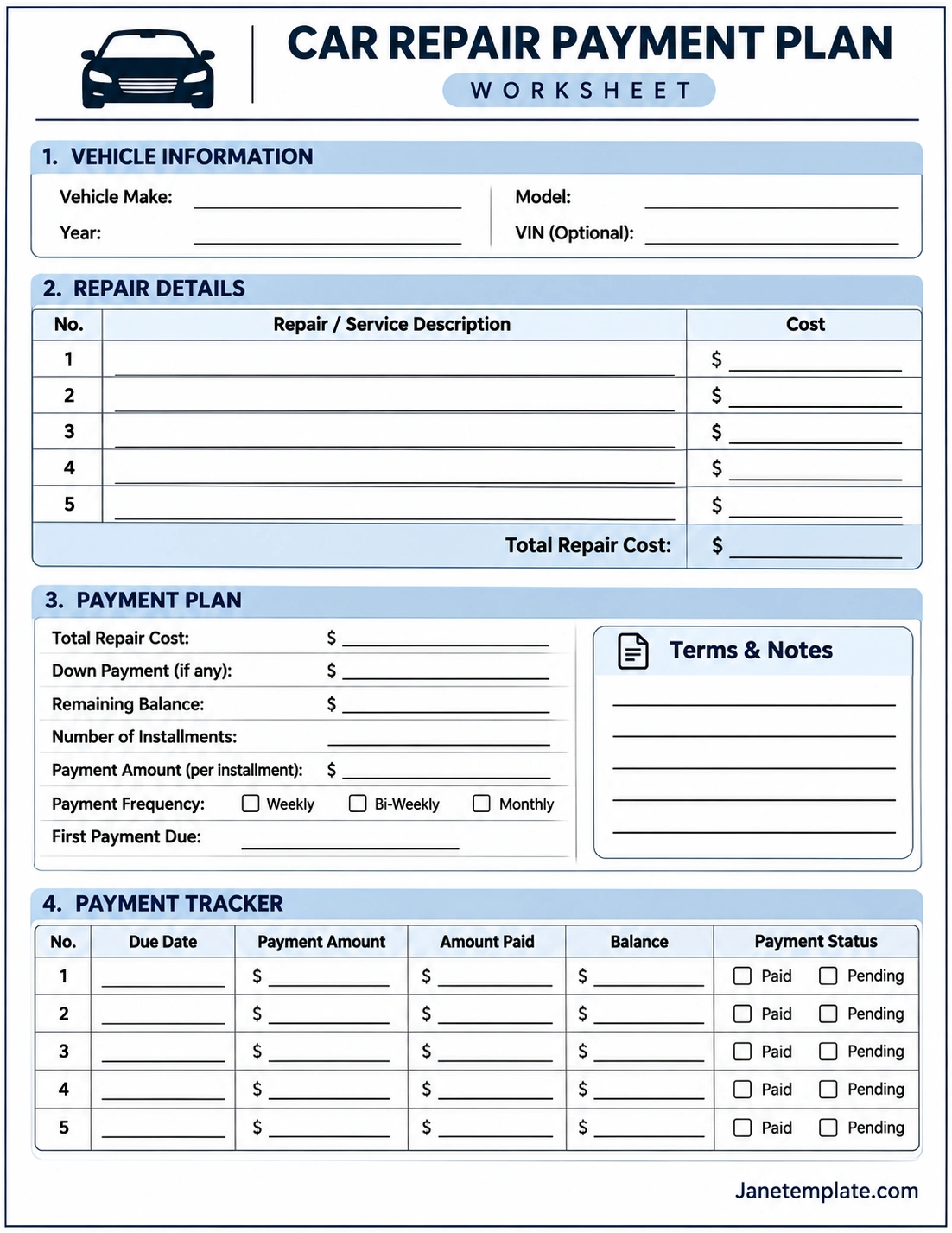
A useful worksheet should include vehicle information, a repair cost breakdown, the total repair expense, down payment, remaining balance, installment frequency, and a payment tracker. A notes section can also be used to record special conditions or reminders.
The sample below features a clean, modern layout with separate sections for repair details and payment tracking. It is designed to help vehicle owners organize expenses, calculate installment amounts, and monitor payments until the repair balance is settled.
Car Repair Payment Plan vs. Auto Repair Financing
Although these terms are sometimes used interchangeably, a payment plan worksheet and auto repair financing are not necessarily the same thing.
Car Repair Payment Plan
A car repair payment plan describes how a repair expense will be paid over time. It may be a simple budgeting schedule or a written installment arrangement offered directly by a repair provider.
A worksheet helps track the amounts and due dates, but it does not automatically provide financing or create a credit agreement.
Auto Repair Financing
Auto repair financing generally involves a financing provider, credit product, or other formal arrangement that allows customers to pay for repairs over time. Depending on the provider, it may involve interest, fees, credit checks, and specific repayment conditions.
Before accepting financing, review the annual percentage rate (APR), total repayment amount, fees, promotional terms, and consequences of missed payments.
Frequently Asked Questions About Car Repair Payment Plans
What is a car repair payment plan?
A car repair payment plan is an arrangement that allows vehicle repair expenses to be paid in scheduled installments instead of one lump sum. It can also refer to a worksheet used to calculate and track those payments.
Can I pay for car repairs in installments?
Some auto repair shops and financing providers offer installment options. Availability depends on the provider, eligibility requirements, and the terms of the arrangement. Ask about payment options before authorizing the repair.
How do I calculate monthly car repair payments?
For a simple plan without interest or additional fees, subtract the down payment from the total repair cost and divide the remaining balance by the number of monthly installments. If interest or fees apply, use the actual repayment schedule provided by the financing company or repair shop.
What should a car repair payment agreement include?
A written agreement should identify the parties, vehicle, approved repair services, total cost, down payment, remaining balance, installment amounts, due dates, payment methods, and any applicable fees or conditions. Both parties should review and retain a copy.
Does a car repair payment plan charge interest?
Not always. Some repair providers may offer interest-free arrangements, while other payment options involve interest or administrative fees. Always review the complete terms and total repayment amount before agreeing.
Can I use a car repair payment plan worksheet for personal budgeting?
Yes. A worksheet can help you estimate repair expenses, organize installment dates, and monitor the remaining balance. It is useful even if you are paying the repair cost yourself without a formal financing arrangement.
What happens if I miss a car repair payment?
The consequences depend on the agreement or financing terms. Possible consequences may include late fees, additional interest, collection activity, or other remedies permitted by the contract and applicable law. Contact the provider promptly if you expect difficulty making a scheduled payment.
Should I sign a written car repair payment agreement?
If a repair shop or another party offers an installment arrangement, getting the terms in writing is a sensible way to document the responsibilities of everyone involved. Review the payment schedule, fees, and other conditions before signing.
Conclusion
A car repair payment plan can make unexpected vehicle expenses easier to organize and manage. By recording repair costs, calculating the remaining balance, and creating a realistic installment schedule, you can keep track of your financial obligations throughout the repair process.
Whether you use a printable car repair payment plan worksheet for personal budgeting or document an installment arrangement with an auto repair shop, clear records are essential. Review all costs, understand the payment terms, and update your tracker after every payment.
With a well-organized payment plan, you can manage vehicle repair expenses more confidently while keeping your budget and payment responsibilities in view.
Download: Car Repair Payment Plan Template
